Bangalore city is one of the premier cities in India having population of nearly 12 million and vehicle population of about 7 million. The density of vehicle population in Bangalore is highest when compared with any city in India. Practically every second person is Bangalore has a vehicle. This large number of vehicles without adequate road capacity has lead to traffic congestion, longer journey time and low average speed.
The growth of vehicles in Bengaluru city can be seen from the following table and graph:
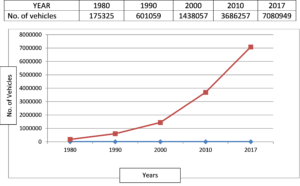
Traffic congestion is alarming during peak hours in peripheral areas like Hosur Road, Bannerghatta Road, Old Madras Road, ITPL area, Nagawara area and Koramangala Inner Ring Road. In these areas employees of various organizations daily commute in their personal vehicles. It is seen that most of the vehicles driven to and from work places are single occupancy cars. These single occupancy cars occupy considerable road capacity leading to longer traffic queue lengths resulting in congestion.
Since it is not possible to curb purchase of new vehicles and increase the capacity of the roads immediately, the best solution for reducing traffic congestion is to reduce vehicles on roads. Car pooling or car sharing is one of the effective methods to reduce vehicles on roads. Car pooling not only helps in reducing congestion, but also in reducing pollution levels, conservation of fuel and leads to considerable saving for commuters.
Carpooling is sharing of car space so that more than one person can travel in a car. By having more people using one vehicle, carpooling reduces each person’s travel costs such as fuel costs, tolls, and the stress of driving. Carpooling is also seen as a more environmental friendly and sustainable way to travel as sharing journeys reduces air pollution, traffic congestion on the roads, and the need for parking. Carpool commuting is more popular for people who work in places with more jobs nearby and who live in places with higher residential densities. In addition, carpooling is significantly correlated with transport operating costs, including fuel prices and commute length, and also time spent with others.
The system works through carpooling programs which are designed to promote ride sharing by identifying riders with similar origins and estimations. Using a data base of interested riders, employers and transport agencies can promote this in the congested IT corridors of Bengaluru city. Companies which has large number of employers can encourage carpooling through incentives such as flexible work schedules, free parking spaces and fuel allowances.
Finally carpooling also has the benefit of social interactions. A little chat on common interest, cribbing about traffic, work, wife or husband might bring a much needed smile and reduce travel stress considerably. Who knows, you might find a new job or a new business deal while chatting with fellow riders.
Bengaluru Traffic Police had initiated many programs to encourage carpooling in the past. Many applications are available in internet which provides details of interested commuters along with their daily commuting routs and origins/destinations. Commuters who travel in private vehicle, especially in the congested areas in city should adopt Car Pooling to help police in reducing traffic congestion and make the city more livable.