Road traffic injuries are a major public health problem and a leading cause of death and injury around the world. Each year nearly 1.2 million people die as a result of road clashes, and millions more are injured or disabled. This number is higher than deaths due to natural calamities or any contagious disease. Most of the victims of road accidents are vulnerable road users like pedestrians, cyclists and tow wheeler riders. In most cases, people killed and injured are men in the age group of 15 – 45 years which is known as productive age in any economy. The death results in loss of precious human resources in the country and total disaster for the families of the victims.
In Karnataka, annually about 10,000 people lose their lives and about 50,000 people are injured due to road accidents. Karnataka State is in 4th position in terms of road accident fatalities among Indian states. The following table provides details of accident fatalities and injuries for the last 10 years;
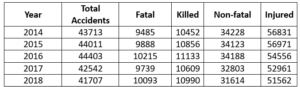
Karnataka State Police is highly concerned about the steep rise in the number of accidents, injuries and fatalities in recent years. It is the ground reality that road accidents have now become a public concern and the victims are mainly from poor sectors of the society and vulnerable road users like pedestrians, cyclists and two wheeler users. There are many deficiencies in the infrastructure, enforcement, emergency response etc., which need to be addressed cumulatively. Achieving traffic safety only by enforcement is not a judicious approach and need backing in the form of better road design, increased awareness about traffic rules and regulations, administrative support to name a few.
Therefore, taking cognizance of the same, the proper analysis of accidents is necessary in order to improve road safety. Studying the accident details intricately will bring out the various anomalies and identify the necessary mitigation measures for the same.
The various causes of road accidents are;
- Road users – Excessive speed and rash driving, violation of traffic rules, failure to perceive traffic situation or sign or signal in adequate time, carelessness, fatigue, alcohol, sleep etc.
- Vehicle – Defects such as failure of brakes, steering system, tyre burst, lighting system.
- Road Condition – Skidding road surface, pot holes, ruts.
- Road Design – Defective geometric design like inadequate sight distrance, inadequate width of shoulders, improper curve design, improper traffic congrol devices and improper lighting.
- Environmental factors – Unfavorable weather conditions like mist, snow smoke and heavy rainfall which restrict normal visibility and makes driving unsafe.
- Other causes – Improper location of advertisement boards, gate of level crossing not closed when required etc.
Most road accidents are caused by human error. Research has shown that road user’s error accounts for over 80 per cent of all road accident fatalities and injuries. Apart from strict enforcement and regulation, educating the road users play an important role in creating awareness about safety on roads leading to reduction in accidents. Effective road safety campaigns need to be designed to influence road users’ behavior.
Road safety campaigns have to be aimed at specific road user groups and relevant campaigning materials and procedure have to be followed. Separate campaigns should be designed for different road users.
Different road user groups are educated differently and they are;
- School Children: The school children should be thought the rules of the road, correct manner of crossing etc., by introducing necessary instruction in the schools for the children and by the help of posters exhibiting the serious consequences due to carelessness while crossing the road.
- Pedestrians: The most vulnerable road user group is the pedestrians and constitute a large percentage in total casualties. They must be targeted on road and awareness has to be created regarding use of footpaths. 3D pedestrian crossings, high raised pedestrian crossings, operation of pelican signals, through public address systems, distributing pamphlets and leaflets and on-spot skits and flash mobs.
- Bus commuters: The bus commuters and even drivers have to be educated regarding proper use of bus bays and stands to stop the buses, safe alighting boarding, use of footpaths, pedestrian crossings. Awareness has to be created regarding the locations of new bus stands / bays from work places and residential areas to popularize public transport.
- Footpath vendors: The footpath vendors must be educated regarding the ill-effects of footpath encroachment and must be encouraged to practice safety.
- Drivers of Transport Vehicles: Special training should be given to drivers of transport vehicles like buses, trucks, taxis and auto rickshaws to follow traffic rules at all times. They should be sensitized about ill effect of drunken driving, over speeding and haphazard parking.
- Two Wheeler Riders: Since 40 per cent of the road accident victims are two wheeler riders, the focus of road safety education should be on wearing of helmets and lane discipline.
CONCLUSION:
Road safety cannot be achieved by Police alone. Apart from bringing the violators to penalty, the above mentioned awareness programmes to educate citizens should be undertaken. Non-Governmental Organizations and civil society should join hands with enforcement agencies to evolve effective strategies to ensure greater safety on roads.