Human trafficking is known as the 3rd biggest criminal industry after narcotic drugs and illegal arms supply. Generally organized crime of human trafficking extends beyond state and national boundaries. It is also multi-dimensional involving elements of several crimes like kidnapping, abduction, buying and selling of humans, bonded labour, child labour and sexual exploitation. The ugliest face of human trafficking is trafficking of girls for sexual exploitation. In India, 46% of women and girls trafficked are for commercial sexual exploitation, 27% for domestic servitude and 27% for forced labour. West Bengal and Jharkhand accounts for the highest number of human trafficking cases for sexual exploitation.
Trafficking is defined by Article 3 of UN Protocol to prevent suppress and punish trafficking of persons (2000) as; trafficking in persons shall mean the recruitment, transportation, transfer, harboring or receipt of persons, by means of the threat or use of force or other forms of coercion of abduction, of fraud, of deception, of the abuse of power or of a position of vulnerability or of the giving or of receiving of payments or benefits to achieve the consent of a person having control over another persons, for the purpose of exploitation. Exploitation shall include, at a minimum, the exploitation of the prostitution of others or other forms of sexual exploitation, forced labour services, slavery or practices similar to slavery, servitude or the removal of organs.
Generally reasons for human trafficking can be attributed to demand and supply factors. The supply factors are due to poverty, gender bias, lack of employment opportunities, social and religious practices and lack of awareness among vulnerable sections of society. On the other hand, from the point of view of criminals, human trafficking is a crime with high returns, due to demand for cheap labour, pornography and prostitution. Weak law enforcement also contributes to increase in trafficking.
World over every nation strives to end the menace of human trafficking. International statutes like UN Declaration of Human Rights (1948), International convention for suppression of traffic in persons and of the exploitation of the prostitution of others (1950), UN convention against transnational organized crime (2000), UN protocol to prevent, suppress, punish trafficking in persons especially women and children (2000) have evolved effective strategies to combat human trafficking.
Human trafficking is one of the major problems in India. India is the source, destination and transit country for human trafficking. 70 per cent of women and girls trafficked in to urban cities are from within the country. About 30 per cent come from other countries like Bangladesh, Nepal and Baltic States. Indian women are trafficked to Middle East for commercial sexual exploitation. Even migrants who migrate willingly to Middle East and Europe for work as domestic servants and low skilled labourers may also end up as a part of human trafficking industry. Victims of human trafficking in India can be broadly classified as under;
- Children and young women brought from rural areas or sometimes even other states, to be engaged as domestic help in households or various small-scale establishments in urban centers. Many of these people eventually get exploited economically, physically and also sexually.
- Children and adolescents begging or selling knick-knacks on the streets in towns and cities.
- Women and children sold into commercial sex trade market
- People lured to foreign countries by fraudulent recruitment agencies with lucrative job offers, to be employed in mental work involving inhuman working conditions.
- The victims of the illegal organ trade racket.
In order to effectively prevent human trafficking, the Criminal Law Amendment Law 2013 has expanded the scope of Sec. 370 and 370(A) of Indian Penal Code. Apart from this, Sec. 363 to 374 IPC envisages strict penalties for offences like kidnapping, selling of minors for purpose of prostitution and unlawful compulsory labour. The Immoral Trafficking Prevention Act-1986 (ITPA) provides comprehensive safeguards to women and children from commercial sexual exploitation. Apart from this, the Child Labour (Prohibition and Regulation) Act-1986, the Juvenile Justice (Care and Protection of Children) Act, 2000 and the Protection of Children from Sexual Offences Act, 2012 (POCSO) provides for protection of children from all forms of slavery, exploitation and sexual harassment.
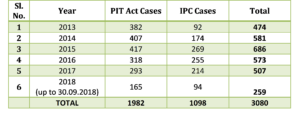
As per National Crime Records Bureau data 8132 human trafficking cases were reported during the year 2016. Out of these, 573 cases are reported in Karnataka alone. The following table provide information about human trafficking cases in Karnataka state for last 6 years.
 Apart from legal remedies, prevention of human trafficking requires several type of interventions. State should focus on creation of compulsory high quality education, employment opportunities and income generation for marginal and vulnerable sections of society. Wide publicity regarding legal and penal provisions against trafficking and sensitizing police and prosecution agencies will help in combating human trafficking effectively. Awareness programmes to educate people especially women and children will go a long way in completely eradicating the evils of human trafficking.