Road traffic injuries are estimated to be the eighth leading cause of death globally and the main cause of death for young people aged 15-29 years. Approximately 1.24 million people die every year on the world’s roads, and another 20 to 50 million sustain nonfatal injuries as a result of road traffic crashes. Most of the victims of road accident are vulnerable road users like pedestrians, cyclists and two wheeler riders. Among them two wheeler riders are at an increase risk of being involved in an accident. This is because they often share the traffic space with fast moving cars, buses, trucks and also because they are less visible. In addition, the lack of physical protection makes them particularly vulnerable to being injured if they are involved in a collision. Therefore wearing of protective gear i.e., helmet is a must for two wheeler drivers and pillion riders. The need for wearing helmet while riding is due to the following reasons;
- Motorcyclists are at high risk in traffic crashes. As per available data, wearing of helmets reduce the risk of head injury by around 69% and death by around 42%.
- Motorcyclists are more prone to crash injuries than car occupants because motorcycles are unenclosed, leaving riders vulnerable to contact with hard objects.
- Helmets are highly effective in preventing brain injuries, which often require extensive and expensive treatment and may result in lifelong disability.
- An estimate shows that in the event of a crash, unhelmeted motorcyclists are 3 times more likely than helmeted riders to suffer traumatic brain injuries, and that motorcycle helmets reduce the likelihood of a crash fatality.
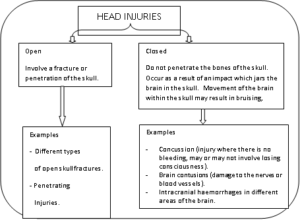
According to World Health Organizations manual for road safety, typically the head injuries due to road accidents can be summarized in the following chart
HOW A HELMET WORKS:
A helmet aims to reduce the risk of serious head and brain injuries by reducing the impact of a force or collusion to the head.
A helmet works in three ways:
- It reduces the decelaration of the skull, and hence the brain movement, by managing the impact. The soft material incorporated in the helmet absorbs some of the impact and therefore the head comes to a halt more slowly. This means that the brain does not hit the skull with such great force.
- It spreads the forces of the impact over a greater surface area so that they are not concentrated on particular areas of the skull.
- It prevents direct contact between the skull and the impacting object by acting as a mechanical barrier between the head and the object.
In Bengaluru city 70% of total vehicle consists of two wheelers. Though the city has good enforcement of traffic rules, but still road accidents involving two wheelers is very high. The following table illustrates two wheeler riders deaths and injuries for the last 5 years.
Table showing Two Wheeler Users killed and injred in road accident for the last 5 years in Bengaluru city.
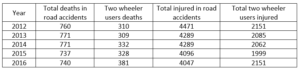
The main reason for the above two wheeler rider deaths is mainly because of non wearing of helmets while using the bike on the road. Wearing of helmet by the rider of the two wheeler was made compulsory in Bengaluru city and other cities of Karnataka since November 2006 and wearing of helmets by rider and pillion rider for the whole state is made compulsory since January 2016. However it is seen that compliance of helmet rule is still less in sub urban areas and outskirts of the city. Some people do not wear the prescribed (ISI standard) helmet and instead wear half helmets which does not protect the head from injuries. In other cities of Karnataka, compliance to the helmet rule is less than 50%.
The need of hour is to evolve effective strategies by enforcement agencies, NGOs and civil society to promote wearing of helmets to save precious life and to ensure greater safety on roads.