Rapid growth of population coupled with the improving socio-economic conditions of people and high concentration of motor vehicles in Bengaluru has contributed to a phenomenal growth of traffic on the city roads. Traffic congestion is the obvious consequence especially when the scope for expansion of roads space is severely limited. Traffic congestion has led to increased journey time, pollution and traffic indiscipline on roads.
The growth of vehicular traffic in Bengaluru City can be summarized below;
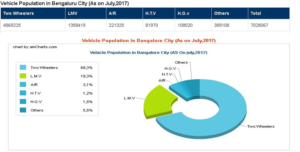
One of the important reasons for traffic congestion in Bengaluru City is lack of adequate public transport system. The City has around 6500 public transport buses and around 40 Kms. of metro connectivity. Accordingly to draft Revised Master Plan for Bengaluru – 2031, the model share of public transport in total over all trips is only 48%. Private vehicles constitute 52% of the total one crore trips per day in Bengaluru. Ideally a city should have 75% of model share of public transport. For eg., in Mumbai the public transport share of total trips is 82% due to good commuter rail network. As a result Mumbai has for less private vehicles when compare to Bengaluru.
It is well known that public transport occupies less road space and causes less pollution per passenger-km than personal vehicles. As such, public transport is a more sustainable form of transport. Therefore, the Stake holder agencies should promote investments in public transport as well as measures that make its use more attractive than in the past. BMTC should increase its fleet to 10,000 buses and 2nd phase of Metro constructions should be completed early. Apart from this, sub-urban rail system connecting areas outside the city and central areas need to be introduced early. People should be encouraged to travel in public modes of transport by giving them incentives. World over urban public transport is highly subsidized to make city travel cheaper and economical. People will shift from personal vehicle to public transport due to cheaper option.
Further Bengaluru City has corridors that have varying densities of travel and hence need technologies that best match the level of demand on the corridor. This often requires different operators managing such systems. However, a good public transport system is one that is perceived by the user as a single system and allows seamless travel between one mode and the other as also between systems managed by different operators. Such seamless interchange is possible if proper inter-change infrastructure is available and users are able to use a single ticket over all such systems. This also requires that a single agency takes responsibility for coordination so that there is a common approach to public transport planning and management.
Employees of major companies, especially IT industry, in Bengaluru have a major role to play in encouraging their employees to travel through Public Transport System. Recent initiatives by some Government agencies to observe Bus Day, No-Traffic Day etc are a welcome move to reduce dependency on private vehicles. A good economic and sustainable public transport system will definitely reduce vehicular traffic on roads and make the city more livable.