Abstract:
Somebody is killed or seriously injured on the world’s roads every six seconds. Road crashes are now the major cause of death worldwide for young people aged between 18 and 30 years. Annually at least 1.2 million people die and 50 million are injured, a scale of death comparable with malaria or tuberculosis. Apart from loss of precious human lives, the cost of road accidents is almost 3 per cent of GDP in developing countries. In India around 1,50,000 people die and about half a million people are injured due to road accidents every year.
The main causes for road accidents are rash and negligent driving, vehicular defects, defective road geometries and environmental factors. There is a need to evolve effective sustainable strategies like road engineering interventions, effective traffic enforcement mechanism, traffic education and awareness measures and robust trauma care and emergency services. Effective interventions also require coordination between various stakeholder agencies responsible for road safety. This article outlines various structural and remedial measures to prevent road traffic accidents and make our roads more safer.
Key Words:
Road safety, Traffic management, Road geometry, Intersections, Road marking, Traffic signages, Informatory signages, Mandatory signages, Cautionery signages, Blackspot, Enforcement mechanism, Head injuries, Drunken driving, Trauma care, Emergency Services.
Road traffic injuries are a major public health problem and a leading cause of death and injury around the world. Each year nearly 1.2 million people die as a result of road clashes, and millions more are injured or disabled. This number is higher than deaths due to natural calamities or any contagious disease. Most of the victims of road accidents are vulnerable road users like pedestrians, cyclists and two-wheeler riders. In most cases, people killed and injured are men in the age group of 15 – 45 years which is known as productive age in any economy. The death results in loss of precious human resources in the country and total disaster for the families of the victims. The following table provides details of road accidents in important cities of India in the year 2020.
Table: 1: Showing Road Accidents in 8 cities of India.
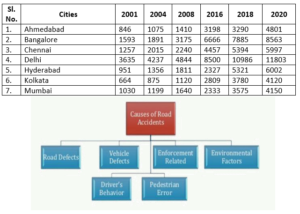
The various causes of road accidents are:
- Road Users: Excessive speed and rash driving, violation of traffic rules, failure to perceive traffic situation or sign or signal in adequate time, carelessness, fatigue, alcohol, sleep etc.
- Vehicle: Defects such as failure of brakes, steering system, tire burst, lighting system.
- Road Condition: Skidding road surface, potholes, ruts.
- Road design: Defective geometric design like inadequate sight distance, inadequate width of shoulders, improper curve design, improper traffic control devices and improper lighting.
- Environmental factors: unfavorable weather conditions like mist, snow, smoke and heavy rainfall which restrict normal visibility and makes driving unsafe.
- Other causes: improper location of advertisement boards, gate of level crossing not closed when required etc.
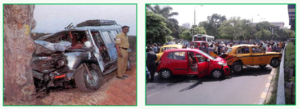
Significance of Road Safety:
The importance of road safety can be explained as follows:
- To minimize accident likelihood and to minimize their severity.
- To minimize the risk of accidents likely to occur on the adjacent road i.e. to avoid creating accidents elsewhere on the network.
- To recognize the importance of safety in highway design to meet the needs and perceptions of all types of road users; and to achieve a balance between needs of different road user types where they may conflict with one another.
- To reduce long-term costs of a project facility, bearing in mind that unsafe design may be expensive or even impossible to correct at a later stage.
- To increase awareness about safe design practices among all those involved in the planning, design, construction and maintenance.
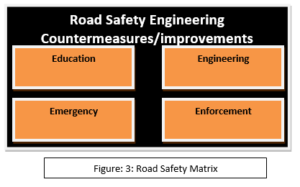
Road safety is achieved by identifying and reducing accident black spots through the four Es of road safety:
- Engineering
- Enforcement
- Emergency response
- Education
Victims of Road Accidents:
Pedestrians are the most vulnerable road users. They account for more than 25 per cent of road accident deaths and injuries in India. In the year 2017, the pedestrian deaths were almost 40 per .
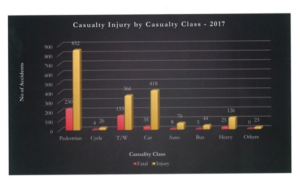
cent of the total fatalities in Bengaluru City. The following table indicates fatalities and injuries of all road users. It is to be noted that pedestrians and two-wheeler riders contribute about 85 per cent of total fatalities in Bengaluru City during 2017.
Road Safety Strategies – Need for NURSP:
A Comprehensive National Urban Road Safety Policy should be developed on the lines of National Urban Transport Policy (NUTP). The National Urban Transport Police should include the following two sets of measures:
- Structural measures which aim at avoiding future traffic accidents by integrating safety principles in the design of the urban systems and its networks as well as in transport planning. The structural or integrated approach obviously applies to new town or new urban developments, but also to traffic and transport plans that aim at reorganizing the use of existing infrastructure to optimize mobility.
- Corrective or remedial measures aim at eliminating some malfunctions in the existing urban systems or road network and its use that have already generated road accidents.
The structural and remedial measures can be further classified into:
- Traffic and Road Engineering Measures
- Traffic Enforcement Measures
- Traffic Education and Awareness Measures
- Trauma Care and Emergency Services
In the following paragraphs, each of the road safety strategies are discussed with focus on enhancing safety on roads;
1. Traffic and Road Engineering Measures:
Traffic engineering can simply be defined as a branch of civil engineering that uses engineering techniques to achieve the safe and efficient movement of people and goods. It focuses mainly on research for safe and efficient traffic flow, such as road hierarchy, horizontal and vertical road alignment, road cross sections, control of access, pedestrian and cyclists’ infrastructure, traffic signs, road surface markings and traffic furniture. The components of traffic and road engineering are discussed below:
a. Road Geometrics (Indian Road Congress)
Geometric design standards in India are prescribed by the Indian Road Congress (IRC) and therefore, all the designs involving highways and streets, intersections, traffic signage and road markings should follow the IRC design specifications which are described as follows:
The classification of urban highways in India is briefly described as below:
-
- Expressways: These are defined as divided arterial highways for motor traffic with partial or full access control and provided grade separation at intersections. Expressways connect major points of traffic generation and are intended to serve trips of medium and long lengths between residential areas, industrial or commercial concentrations and the central business district. Parking, loading and unloading of goods and pedestrian traffic are not permitted on Expressways.
- Arterial Streets: These are meant for through traffic usually on a continuous route and significant intra-urban travel such as between central business district (CBD) and outlying residential or between major suburban centers. Arterial streets collect traffic from the sub-arterial and collector streets. Pedestrians are allowed to cross only at the intersections.
- Sub-arterial streets: Also known as major roads they run within the limits of the town connecting its important centers. They are designed for slow moving traffic and cover a short distance. The sub-arterial roads act as a link between the arterial roads and local roads. They should be provided with safety measures at intersections.
- Collector Streets: This street is primarily intended for collecting and distributing traffic to and from local streets and for providing access to local streets. These may be in business, residential or industrial areas.
- Local Streets: A local street is one primarily intended for access to residence, business or other abutting property and does not carry large volumes of traffic. The local street may be residential, commercial or industrial, depending upon the prominent use of adjoining land. A local street allows unrestricted parking and pedestrian movement.
b. Traffic Signals (Indian Road Congress)
Traffic signals are one of the most effective and flexible active control of traffic. The conflicts arising from movements of traffic in different directions is addressed by time-sharing principle and thereby, traffic signals, when properly designed, located and operated have one or more of the following advantages:
- Signals can provide for an orderly movement of traffic.
- When proper geometric layouts and control measures are employed, they can increase the traffic handling capacity of the intersection.
- They can reduce certain types of accidents, especially the right-angle type and pedestrian accidents.
- Under favorable conditions, they can be coordinated to provide for continuous or nearly continuous movement of traffic at a definite speed along a given corridor.
- They can be used to interrupt heavy traffic at intervals to permit other traffic, vehicle or pedestrian to cross.
- Traffic signals dispense with police control and can thus be economical.
c. Intersections:
An intersection is defined as the general area where two or more highways join or cross. This area is designated for the vehicles to turn to different directions to reach their desired destinations. Its main function is to guide vehicles to their respective directions. The pedestrians also seek the intersections for crossings.
The type of intersection depends upon the type (2 legged, 4-legged, rotary etc.), geometry (flyover, underpass) and control (signalized or unsignalized).
Overall traffic flow depends on the performance of the intersections. Therefore, both from the accident perspective and the capacity perspective, the design of intersections is very important for the traffic engineers especially in the case of urban scenario where the need of the hour is to regulate the traffic flows due to the phenomenal growth of traffic in Indian cities.
d. Road Markings
Road Markings are used as a means of controlling and guiding traffic. They are highly important on roads and intersections as they promote road safety and bring about smooth and harmonious flow of traffic along guided paths of travel. They also serve to supplement the messages conveying certain regulations, information or warnings that cannot otherwise be effectively conveyed to the road users. One advantage with road markings is that they convey the required information to the driver without distracting their attention from the carriageway.
Types of Road Markings
Road markings or carriageway markings compliment the road signs. Markings are painted on the road to guide and regulate the traffic. White is generally used for carriageway (road) markings except those indicating restrictions, for which yellow markings are used. White or yellow together with black are used for kerbs and object marking.
Depending on the actual intersection conditions, carriageway markings of intersections may consist of one or more of the following:
-
- Markings on approaches to intersection
-
-
- Stop lines
- Give way lines
- Pedestrian crossing
- Cyclist crossing
- Direction arrows
- Protected right turn lanes
-
2. Markings on an intersection area
-
-
- Markings at rotaries
- Box markings
- Continuity lines
- Parking prohibited lines
-
e. Traffic Signage
To properly guide and control the traffic approaching junctions, traffic signs and signals are installed. IRC provides a more detailed description of various traffic signs and their applications. Traffic signage should be installed only by the authority of law. Unofficial and non-essential signs should not be permitted. Signs should be put up only after traffic engineering studies and sound engineering judgment.
The posting of traffic signs must be done with adequate care so that they perform their intended function most effectively, in as much as the sign must be posted ahead of the spot to which it refers. When more than one sign is to be posted, they should be adequately separated in space to be seen one at a time and convey the message with complete effect. Signs with reflective properties (preferably retro-reflective type) must be used to meet the requirements of night traffic.
There are three types of traffic signs:
-
- Mandatory / Regulatory Signs
- Information Signs
- Cautionary Signs
Mandatory/Regulatory Signs:
Mandatory signs are part of regulatory signs and are intended to convey definite positive instructions when it is desired that motorists take some positive action. These signs are for informing the users about the specific laws & regulations to ensure safety and to ensure clear movement of traffic. As the name suggests, any violation of these signs will spell trouble and will be considered as a legal offence.
Most of the signs under this category are round shaped, may get the symbols painted white on a blue background, having a white border or maybe there is a white background to carry black symbols with a red border.
Informatory Signs
Informatory signs are intended to guide the motorist along streets and highways, to inform them of intersecting routes, to direct them to cities, towns, villages or other important destinations, to identify nearby rivers and streams, parks, forests and historical sites and generally to give drivers such information as will help them along their way in the most simple, direct manner possible.
They usually get a broad sky-blue border, while the symbol is composed of black color. Indian Road Congress (IRC 067) code of practice for road signs stipulates the specifications for the signage including aspects such as the size, colour, font color etc.
Cautionary Signs:
These signs are used to warn the road users of the existence of certain hazardous conditions either on or adjacent to the roadway, so that the motorists are cautious and take the desired corrective action. Some of the signs, which fall under this category, are provided as follows:
f. Road Furniture
Road furniture is a collective term for objects and pieces of equipment installed on streets and roads for various purposes. It includes benches, traffic barriers, bollards, post boxes, phone boxes, streetlamps, traffic lights, traffic signs, bus stops, tram stops, taxi stands, public lavatories, fountains, watering troughs, memorials, public sculptures, and waste receptacles.
g. Accident Black Spots:
According to Ministry of Road Traffic and Highways, an accident black spot is defined as “a stretch of road of about 500m in length in which either (a) five road accidents took place during the last three consecutive calendar years involving fatalities/ grievous injuries or (b) ten fatalities took place during the last three consecutive calendar years.”
IDENTIFICATION OF BLACK SPOTS
The statistical analysis of accidents is carried out periodically at critical locations or road stretches which will help to arrive at suitable measures to effectively decrease accident rates. It is the measure (or estimates) of the number and severity of accident. These statistics reports are to be maintained zone-wise.
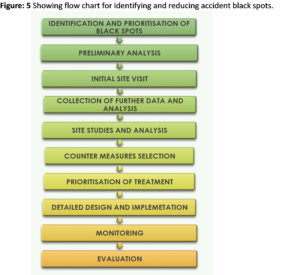
Accident prone stretches of different roads may be assessed by finding the accident density per length of the road. The places of accidents are marked on the map and the points of their clustering (BLACK SPOT) are determined. By statistical study of accident occurrence at a road or location or zone of study for a long period of time it is possible to predict with reasonable accuracy the probability of accident occurrence per day or relative safety of different classes of road users in that location. The interpretation of the statistical data is very important to provide insights to the problem. For identifying and reducing accident blackspots, the procedure is represented in the following flow chart.
2. TRAFFIC ENFORCEMENT STRATEGIES:
Good and efficient traffic planning and engineering will be of no use if people do not follow the traffic rules. Here comes the role of traffic police. Road users tend to violate the rules if there is poor enforcement and regulations. In India, metropolitan cities suffer from widespread road indiscipline and only an effective policing system can bring discipline on roads and ensure road safety.
The enforcement is dependent on its ability to create a meaningful warning or threat to road users. To achieve this, the primary focus should be on increasing surveillance levels to ensure that perceived nervousness risk is high. The primary role and objective of a traffic enforcement law will be in the reduction of fatal and serious injury road crashes, while the secondary considerations would be to ensure the free flow of traffic.
In India the following laws are related to traffic management and enforcement:
-
- Indian Motor Vehicles Act 1988
- Central Motor Vehicles Rules 1989
- State Motor Vehicles Rules
- Traffic Control Act
- Rules of Road Regulation 1989
- Motor Vehicle Insurance (3rd Party Risks)
- Vehicle Taxation Acts of States
- Carriage by Road Act, 2007
- Carriage by Road Rules, 2011
- Motor Transport Workers Act, 1961
- Karnataka Motor Transport Workers Rules, 1964
- Fatal Accidents Act, 1855
- Public Liability Insurance Act, 1991
- Public Liability Insurance Rules, 1991
- Road Transport Corporations Act, 1950
These laws govern traffic and regulate vehicular movements. They have been developed over a period of time to facilitate the orderly and timely flow of traffic. Traffic enforcement is the implementation and compliance of these traffic laws.
The traffic police is responsible for ensuring the enforcement of traffic laws. They must therefore be trained to make sure that the rules of the Highway Code are applied and be given the resources to do the job properly. However, both professional development possibilities and resources are in short supply in low and middle-income countries.
The road checks are to be implemented systematically to check road rage or indiscipline. Whether one likes it or not, the fear of being caught changes the behaviour of the road users.
Most individuals truly believe that they are good drivers capable of maintaining control of their vehicle even at high speed and that they can comfortably handle a few drinks before driving. The longing for freedom often makes us forget (or underestimate) the risk we are taking both for ourselves and for others in the shared road space. No game of football can be played without a competent, respected and neutral referee, who can apply a set of rules that are known to all. The same applies to road safety, but it is by no means a game. If something goes wrong, loss of life and property is the only result.
A system should be put in place that ensures fines are properly paid, rather than pocketed by potentially corrupt police officials. Police officials should receive training on the impact of road crashes on society and public health in order to have a better appreciation as to why their job of enforcing traffic laws is so important. Police forces must also have access to the technical equipment they need to do their jobs well (such as radars, breathalyzers, as well as patrol cars). Legislation on, for example, drinking and driving, has little meaning if the traffic police do not have the power or equipment required to enforce the laws. In the interim, accidents continue to take place and people continue to suffer injuries and die.
Some countries have opted for deploying a specialized traffic police force. Such a specialized team of traffic police officers has proven particularly useful in low and middle-income countries, where it may take time to increase the budgets allocated to the police for road safety. The police and gendarmerie also have an educational role to play by communicating through the media. This approach has been shown to be effective in communicating important messages to the public and it places the police force at the heart of the preventive system.
Experience has also shown that national and provincial road safety committees that involve the police in their policymaking and action plans have made quicker progress in reducing road crashes than in countries where they are not involved.
Automated Enforcement: Traffic police in Indian cities follows the traditional method of booking the offenders through the manual challan system. This system is outdated and suffers from the following drawbacks:
-
- The system is highly arbitrary and gives scope for harassment.
- There is no recorded evidence of the violation committed.
- There is no record of repeat offences committed and hence higher penalty for habitual offenders is not possible.
- Serving of summons and warrants puts additional burden on traffic police.
- It provides great scope for corruption.
The afore-mentioned drawbacks can be eliminated through automated enforcement. Automated enforcement is one of the technologies for enforcing traffic rules and prosecuting traffic offenders. The important components of automated enforcement are:
-
- Central Data Server
- Simputers/palm tops for enforcement officer
- Enforcement and Surveillance Cameras
- Electronic fine collection systems
The violation of traffic rules by motorists are captured through enforcement cameras and by traffic policemen posted on roads. These violations are fed into the central server and notices are generated. These notices are sent to the owners of the vehicles by post. On receipt of the notice, the owner of the vehicle or the violator has to remit the fine amount in any of the fine collection centers.
Though automated enforcement is very common in west as well as in Asia Pacific countries, its implementation in India has started only in Bangalore city. Other metropolitan cities can adopt for transparent and strict enforcement. A separate chapter is included in this book on enforcement automation.
Enforcement to Prevent Road Accidents:
The traffic police should concentrate on the core traffic violations which result in road accidents. They are as follows:
-
- Drunken driving
- Over speeding
- Lane indiscipline
- Driving without competency or without valid driving license
- Driving without safety gears such as helmets and seat belts
- Jaywalking on roads by pedestrians
- Jumping traffic signal lights
- Driving with defective lights and defective tires
- Overloading and foot-board travel in case of transport vehicles
- Parking violations
Traffic police should concentrate on looking for violators of the above and bring in greater discipline on roads which will in turn result in reduction of road accidents.
Some of the above violations which result in road accidents are discussed in detail in the following paragraphs:
- Over speeding – Always a killer
Over speeding is one of the leading causes for the road accidents in both developed as well as developing countries. According to National Crime Records Bureau (NCRB), most of the road accidents in India were due to over speeding accounting for 43.7% of total accidents which resulted in 69,969 deaths and 2,12,815 persons being injured.
Excessive speed is a key risk factor for road accidents and greater severity of the injuries in the event of a crash. In accidents occurring at higher speeds, there is greater generation and transfer of mechanical energy to the affected person. When the transfer of energy occurs to the human body in excessive amounts, damage to body organs occur when it exceeds the physiological tolerance. The level of damage to the body is influenced by the shape and rigidity of the colliding object along with velocity of the impact.
There are many reasons for over speeding. Generally, young people indulge in fun and pleasure by over speeding while driving a vehicle. For many youngsters it is a thrilling experience. Sometimes, people who have deadlines try to cover distances in shorter period of time. In many congested roads, especially in Bengaluru city, people over-speed and even dangerously over-take from both sides of the road, leading to road accidents.
In order to prevent fatalities on roads, there is a need to adopt sustainable engineering, enforcement and education strategies to manage speed on roads. Some of these strategies are:
-
- Speed limits should be fixed scientifically for different categories of roads depending on different functions of the road and its usage by various road users.
- While designing and developing roads, appropriate safeguards for vulnerable road users like pedestrians, cyclists and two wheeler riders should be incorporated.
- Appropriate visible signages needs to be erected for better information of road users.
- Installation of speed governors for all public transport vehicles and goods vehicles should be made mandatory at the manufacturing stage itself.
- Automatic speed enforcement devices such as speed cameras and speed interceptors should be deployed by enforcement agencies on all highways and city roads.
- Stringent penalties like cancellation of driving licences should be incorporated in the penal laws.
- Increased public awareness and improving compliance towards speed restrictions needs to be given importance through campaigns and public education programs.
Apart from the above, the Intelligent Speed Adaptation system, which is popular in many western countries, can be used to maintain safe speed levels while driving on roads.
Intelligent Speed Adaptation (ISA) is a system that shows great promise in terms of its potential impact on the incidence of road casualties. With this system, the vehicle “knows” the permitted or recommended maximum speed for the road along which it is travelling.
The standard system uses an in-vehicle digital road map onto which speed limits have been coded, combined with a satellite positioning system. The level at which the system intervenes to control the speed of the vehicle can be on the following:
-
- Advisory – the driver is informed of the speed limit and when it is being exceeded.
- Voluntary – the system is linked to the vehicle controls, but the driver can choose whether and when to override it.
- Mandatory – no override of the system is possible.
ISA may take some more time for adaptation on Indian roads and vehicles. Till such time the above-mentioned strategies should be implemented to prevent road accident and ensure greater safety on roads.
- Drunken Driving:
One of the major causes of road accidents is drunken driving. The risk of being involved in a road accident is higher in case of drivers who consume alcohol even in small amounts and drive their vehicle. A person under the influence of alcohol can not only injure themselves, but can injure or kill others as well. Accidents by a drunken driver are generally due to poor judgement, slow reaction, delayed reflexes, poor visual attention, improper co-ordination and difficulty in identifying road bottlenecks. Consumption of alcohol also results in a euphoric effect which makes an individual shed their inhibitions resulting in the person tending to violate traffic safety rules.
The available data on road accidents indicates that one-third of accidents occur at night which is generally due to drunken driving. Recognizing this aspect, almost every nation has anti-drunken driving laws in place. These laws describe the acceptable level of alcohol consumption while driving. In India, alcohol beyond 30 mg per 100 ml of blood is considered as a violation.
According to World Health Organization (WHO), in most high-income countries, about 20% of fatally injured drivers had excess alcohol in their blood i.e. blood alcohol concentration (BAC) in excess of the legal limit. In contrast, studies in low and middle income countries have shown that between 33% and 69% of fatally injured drivers and between 8% and 29% of non-fatally injured drivers had consumed alcohol before their crash.
In the years to come, alcohol use and driving will be a major problem due to rapid motorization, increase in availability of alcohol and rising income levels of people. There is a need to evolve effective measures to control drunken driving and save human lives.
Severe and stringent punishment for drunken drivers will be an effective deterrence. According to Sec 185 of Central Motor Vehicles Act, 1988, “Driving by a drunken person or by a person under the influence of drugs, whoever, while driving, or attempting to drive a motor vehicle, (a) has, in his blood, alcohol exceeding 30 mg per 100 ml of blood detected in a test by a breathalyzer or (b) is under this influence of a drug to such an extent as to be incapable of exercising proper control over the vehicle, shall be punishable for the first offence with imprisonment for a term which may extend to six months, or with fine which may extend to two thousand rupees, or with both: and for a second or subsequent offence, if committed within three years of the commission of the previous similar offence, with imprisonment for a term which may extend to two years, or with fine which may extend to three thousand rupees or with both”.
The above punishment is not stringent compared to the enormous damage a drunken driver can inflict on themselves or another person(s). Therefore, this section should be amended to provide for greater punishment.
Cancellation of driving licence, confiscation of vehicle and vehicle registration cancellations are some of the suggested detrimental punishments for drunken driving.
- Prevention of Head Injuries Through Helmets:
Most of the victims of road accidents are vulnerable road users like pedestrians, cyclists and two wheeler riders. Among them, two-wheeler riders are at an increased risk of being involved in accidents. This is because they often share the traffic space with fast moving cars, buses, trucks and because they are less visible. In addition, the lack of physical protection makes them particularly vulnerable to being injured if they are involved in a collision. Therefore, wearing of protective gear i.e., helmet is a must for two-wheeler drivers and pillion riders. The need for wearing helmet while riding is due to the following reasons:
Motorcyclists are at a high risk in traffic crashes. As per available data, wearing of helmets reduces the risk of head injury by around 69% and death by around 42%.
Motorcyclists are more prone to crash injuries than car occupants because motorcycles are unenclosed, leaving riders vulnerable to contact with hard objects.
Helmets are highly effective in preventing brain injuries, which often require extensive and expensive treatment and may result in lifelong disability.
An estimate shows that in the event of a crash, un-helmeted motorcyclists are 3 times more likely than helmeted riders to suffer traumatic brain injuries, and that motorcycle helmets reduce the likelihood of a crash fatality.
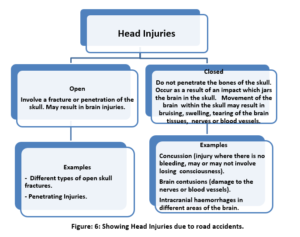
According to World Health Organization’s manual for road safety, typically the head injuries due to road accidents can be summarized in the following chart;
How a helmet works:
A helmet aims to reduce the risk of serious head and brain injuries by reducing the impact of a force or collusion to the head. A helmet works in three ways:
-
- It reduces the deceleration of the skull, and hence the brain movement, by managing the impact. The soft material incorporated in the helmet absorbs some of the impact and therefore the head comes to a halt more slowly. This means that the brain does not hit the skull with a great force.
- It spreads the forces of the impact over a greater surface area so that they are not concentrated on any particular areas of the skull.
- It prevents direct contact between the skull and the impacting object by acting as a mechanical barrier between the head and the object.
In Bengaluru city, 70% of all vehicles are two wheelers. Though the city has good enforcement of traffic rules, road accidents involving two wheelers is still very high. The following table illustrates two-wheeler riders’ deaths and injuries for the last 5 years.
Table: 2: Showing Two-Wheeler Users killed and injred in road accident for the last 5 years in Bengaluru city.

The main reason for two-wheeler rider deaths is due to two-wheeler riders not wearing helmets while driving on the road. Wearing of helmet by the rider of the two-wheeler was made compulsory in Bengaluru city and other cities of Karnataka since November 2006 and wearing of helmets by rider and pillion rider for the whole state was made compulsory in January 2016. However, it is seen that compliance of helmet rule is still less in suburban areas and outskirts of the city. Some people do not wear the prescribed (ISI standard) helmet and instead wear a half helmet which does not protect the head from injuries. In other cities of Karnataka, compliance to the helmet rule is less than 50%.
The need of the hour is to evolve effective strategies by enforcement agencies, NGOs and civil society to promote wearing of helmets to save life and to ensure greater safety on roads.
- Seat Belt for Responsible Driving:
A seat belt, (also called a safety belt), is a safety harness designed to keep the occupant of a vehicle inside the vehicle and to reduce/minimize rapid movements that may result from a collision or a sudden stop. As part of an overall occupant restraint system, seat belts are intended to reduce injuries by stopping the wearer from hitting hard interior elements or the vehicle or other passengers (the so called second impact) and by preventing the passengers from being thrown from the vehicle.
The presence of a seatbelt protects the occupant from rolling forwards, being ejected outside and, in turn, hitting objects within the car. Secondly, properly fastened seat belts distribute the forces of rapid deceleration over larger and stronger parts of the body, such as the chest, hips, and shoulders. The seat belt stretches slightly to slow down the body movement. The difference between the belted person’s stopping distance and the unbelted person’s stopping distance is significant, and often the difference is between life and death. Thirdly, it holds the occupant in the same position by keeping them in their seat which prevents them from being thrown around in a crash. An added advantage is that a person who is belted will cause a smaller number of injuries to others as well.
Mandatory Seat Belt Use Laws:
Mandatory seat belt use has been one of road injury prevention’s greatest success stories and has saved many lives. Occupant restraint first began to be fitted in cars in the late 1960s and the first law on their mandatory use was passed in Victoria, Australia, in 1971. By the end of that year, the number of car occupant deaths in Victoria had fallen by 18 per cent. By 1975 the number had fallen by 26%. Following the experience of Victoria, many countries introduced seat belt laws, which led to many hundreds of thousands of lives saved worldwide. Now, high end cars have in-inbuilt mechanisms to ensure that driver and co-passenger wear seat belts, failing which a beep or a hooter starts blaring to remind the vehicle occupant.
In India, wearing of seat belt was made mandatory for the drivers and front passenger in the year 1994. The Indian Motor Vehicles Act, Section 125 stipulates that all motor cars should be fitted with seat belts. The state governments have the responsibility of implementing these laws through appropriate notification and legislation. However, it is common to see many drivers and front seat occupants not using the seat belt.
The total number of cases booked by Bengaluru Traffic Police during the last 5 years of its implementation is as follows:
Table 3: showing seat belt cases booked by Bengaluru Traffic Police for the last ten years
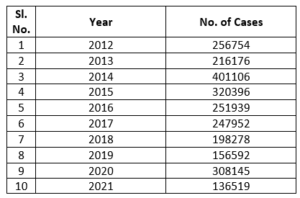
Though some importance is given to create awareness and implement the seat belt rule in Bengaluru City, sadly it is neglected in other cities and highways. Since road accident fatalities and injuries are comparatively higher on highways, policy makers and enforcement officers should give utmost importance to ensure that every vehicle occupant wears seat belts. Penalties for not using seat belt should be sufficiently increased for greater compliance of the law.
Citizens on their part should adopt the rule in the right spirit to ensure their own safety and safety of others on road.
C. TRAFFIC EDUCATION AND AWARENESS MEASURES:
Educating road users: Road users must be explained about the traffic rules and regulations through different media like press, posters, pamphlets, slides in theatres, banners etc. If possible, the road users should be educated about the traffic rules and regulations by conducting awareness camps in which safety of road users should be taught. Habitual and repeated offenders should be made to undergo training sessions in the traffic training institutes established by the Traffic Police. Since lane discipline is virtually absent in our metropolitan cities, efforts should be made to create awareness about lane discipline for smooth traffic flow and safety.
Creating Public Awareness on Road Safety: Regular campaigns are needed to make the general public aware of road safety. While most initiatives are undertaken by governments, civil society can also play a role in organizing campaigns. Private sector companies such as insurance companies, often participate actively in organizing and funding road safety information campaigns.
Campaigns should preferably focus on one risk factor at a time. Campaigns attempting to cover too broad a range of topics are neither understood nor remembered by the public.
Campaigns should be organized on a large scale, if possible (though not necessarily), in different forms (using radio and TV spots, posters or leaflets) and should be carried by all the main media, including the press radio, television and, increasingly, the Internet.
Finally, it is recommended that several (generally three or four) national campaigns be planned each year to maintain a sufficient level of awareness among the public about road safety. The messages should be repeated as frequently as possible, just like when advertising a commercial product.
Instructive campaigns to prepare the public for new legislation:
A road safety campaign should be prepared in several stages. Take the example of seat belts. Ideally, it would be useful to know prior to the information campaign as to how many road deaths were caused due to non-wearing of seat belts. This information will convince the users. However, as mentioned earlier, not all countries have reliable statistics of this kind.
It is very useful to conduct a preliminary survey in order to identify what proportion of vehicle occupants wear seat belts and the reasons why some members of the public chose not to buckle up. This information could be helpful in developing the right campaign messages and identifying how long a campaign should last. The lower the public’s awareness about the critical reasons for wearing a seat belt, the more time may be needed to educate them on the benefits of buckling up. Several campaigns, repeated regularly, will be required.
The campaign message should put across in simple, clear terms why seat belts should be worn, the main reason being to save lives. The help of specialized advertising or marketing agencies may be sought. There are also many examples of campaigns on the Internet. In addition to promotional messages, the testimonies of crash victims or their families are often effective.
It is very useful to connect a campaign with a slogan. Slogans like “Fastened to life” or “A click is better than a crash” are easy to remember.
The campaign needs the right dosage between posters and radio and TV spots, but most important is that it needs to be well publicized. Efforts may have been wasted and the objective lost if the campaign publicity is not well spread.
When the spontaneous use of seat belts reaches a satisfactory level (to be defined by each country), the public is then ready for the next stage, which consists of making the wearing of seat belts compulsory.
Campaigns backed up by enforcement: Experience has shown that a truly effective road safety campaign must include enforcement and penalties. If these are lacking, the campaign will have little sustainable effect on reducing road crash fatalities and injuries, with only spontaneous users of seat belts continuing to buckle up.
Spontaneous use of seat belts describes the fraction of the population who are already convinced that seat belts are useful and who do not need police controls to make them wear them. In cases where legislation has already been passed but is not followed by enforcement, road safety campaigns have the effect of invalidating the law and discrediting the police. It may then be necessary to wait a few months or even years to begin again with a new campaign.
Working closely with the traffic police prior to the campaign can be an extremely effective means of motivating them to enforce the traffic law on wearing seat belts. Preparation work involving the traffic police is crucial, yet it is often overlooked.
The date of the campaign launch and its duration should be announced clearly to the public and sufficiently ahead of the event. Information must be provided to the public regarding fines and a date should be set for the start of police sanctioning. Experience has shown that it is worth allowing for a probationary period (of a few weeks), during which the police will carry out checks but not impose fines. This will convince the public that the measure is not to be taken lightly and that it is best to prepare for the time when penalties will be enforced. It also allows for adjusting either the intensity or the duration of the campaign should there be a general impression that things have moved too quickly. Many countries have experienced a situation where road legislation has been passed and then repealed several times under public pressure. This needs to be avoided.
In summary, the greatest impact can be made on saving lives and reducing injuries from road crashes by concentrating on a single campaign topic, making sure campaign messages are clear, ensuring that a wide range of media sources are used and that the police is actively engaged in enforcing the traffic law throughout the duration of the campaign.
Other ways of creating awareness among the public: Other approaches exist to raising the public’s awareness of road safety in addition to public information campaigns. Tools that may be considered include the dissemination of leaflets on specific topics, holding events and demonstrations and the participation of influential leaders, artists or well-known sports personalities in interviews of programs broadcast on radio and television.
Role of NGOs: Non-governmental organizations and voluntary organizations can play very important role in creating awareness about the road safety. Corporate organizations, as part of their corporate social responsibility, have taken up some road safety initiatives in the past. M/s Shell India had initiated voluntary Code of Conduct for fleet safety which is a pioneering work in creating awareness about safety by fleet managers. Such initiatives can be emulated to sensitize the people about all aspects of road safety.
D. TRAUMA CARE AND EMERGENCY SERVICES
Emergency services consist of a sequence of lifesaving actions that follow a crash: crash alert, first aid, transport and admission to the closest medical care. Action must be taken in the minutes following a crash. It is a race against time. This requires resources. If one of the links is missing, the sequence will be broken and emergency aid will not be correctly administered.
In the great majority of the world’s countries and despite the dedication of emergency medical staff, emergency services do not work properly due to faulty systems.
A specific emergency number should exist, which is free of charge and well known by the public that connects the caller directly with the emergency services. An easily and rapidly accessible telephone line must also be available. This is far from the case everywhere, despite the widespread use of cell phones.
Secondly, too few people have knowledge of proper first aid. On roads all over the world, the chances of a person who can take immediate protective action and provide lifesaving assistance being at the site of a crash are very low.
There is a widespread shortage of emergency ambulance transport, with or without medical facilities. Either ambulances do not arrive at all or they arrive at the crash scene too late. As a result, road crash victims are generally transported to the hospital using improvised means and are often in very bad condition.
Thirdly, hospitals are desperately ill-equipped and road crash victims often do not receive the necessary care. Even where proper care is available, many crash victims may not be able to have access to it for financial reasons unless friends or family can pay in advance for medical services. This situation applies to both ambulance and medical services in hospitals.
Access to basic health care for the general public depends on the existence of a social insurance system. This system does not exist in many of our cities. Unconscious road crash victims, who are hovering between life and death as the result of a crash that may have taken place miles away from their home, are at an increased disadvantage as they may not be able to prove that they can pay for medical services. Thus, fundamentally improving the emergency rescue services and medical system are urgent components of preventing road crash deaths and long-term disabilities in the great majority of countries around the world.
Developing first aid focusing on road crash injuries: In an ideal world, everyone would be familiar with basic first aid techniques and take regular refresher courses to ensure that this knowledge remains current. This is the policy promoted by the Red Cross Red Crescent Movement, which offers first aid courses to the public all over the world. The movement is looked upon as a global leader in the provision of first aid.
First-aid training should be offered to all individuals, who are most likely to be first at a crash scene and may need to act to save the lives of crash victims. First-aid skills are, therefore, essential for professional drivers (of taxis, minibuses, buses and trucks), police officers, ambulance teams and the staff of roadside first-aid centers, in addition to motorcyclists and drivers in general.
Completing a first-aid course will enable drivers to react more quickly and appropriately in the event of a crash to alleviate the physical and emotional suffering of victims. They will also behave in a more controlled and targeted manner because they are aware of the physical risks involved at a post-crash scene.
First-aid training does not need to be extensive in order to be effective. Four to eight hours are enough to acquire adequate knowledge and skills.
Emergency Rescue Services:
Police and firefighters often arrive at the crash scene before personnel from the emergency medical service. Early intervention by firefighters and rescuers is critical where people are trapped in a vehicle, particularly if it is on fire or submerged under water. Firefighters and police need to be trained, therefore, in basic life support. There should be close cooperation between firefighters and other groups of rescuers, as well as between firefighters and health care providers.
As mentioned earlier, there are risks associated with ambulance transport, both for those transported by the ambulance as well as people in the street. Safety standards must therefore be established for transportation by ambulance – for instance, on the use of child restraints and adult seatbelts.
Casualties on road accidents: It is very essential that victims of road accidents should be provided timely and adequate medical attention to prevent casualties. Western countries, particularly United States of America has one of the best post-accident relief infrastructures. Sadly, Indian cities do not have such good and reliable post accidents trauma centers.
Ambulance services: Some of the metropolitan cities have good ambulance services, but the traffic congestion hampers its efficiency. Comprehensive Trauma Consortium (CTC), a voluntary organization has done yeomen services in Bangalore city by placing about 20 ambulances at important accident-prone areas. This organization, in co-ordination with traffic police and hospitals, provides immediate emergency relief to victims of road accidents.
Data pertaining to injuries: Apart from this, National Institute of Mental Health and Neuro Sciences (NIMHANS) has also taken up the task of collection of data pertaining to injuries in road accidents and analyzing them in a scientific manner to provide good and substantial inputs for evolving effective policies for post accident trauma care.
Rehabilitation of Injured Persons:
For every person who dies in a road traffic crash, many more are left with permanent disabilities. Rehabilitation services are an essential component of the comprehensive package of initial and post hospital care of the injured. They help to minimize future functional disabilities and restore the injured person to an active life within society. The importance of early rehabilitation has been proved, though best practices in treatment programs have yet to be identified. Most countries need to increase the capacity of their health care systems to provide adequate rehabilitation to survivors of road traffic crashes.
High quality treatment and interventions for rehabilitation during the period of hospitalization immediately following an injury are of utmost importance in order to prevent life-threatening complications related to immobilization. However, despite the best management, many people will still become disabled due to road traffic crashes. Efforts should focus on capacity building and personnel training so as to improve the management of survivors of road traffic crashes in the acute phase and thus prevent, as far as possible, the development of permanent disability.
Medical rehabilitation services also play a vital part in helping those living with disabilities to achieve independence and a good quality of life. Among other things, these services can provide mechanical aids that greatly assist affected individuals to be reintegrated into, and participate in, ordinary daily activities, including their work. Such aids, delivered through outpatient departments or outreach services to the home, are often essential in preventing further deterioration.
Many government and non-government organizations play an important role in implementing the structural and remedial measures. The usual organizations in metropolitan cities are:
-
-
- Metropolitan Corporations or City Municipal Corporations
- Urban Development Authorities
- City Transport Corporations
- Traffic Police
- Public Works Department
- Highway Authorities
- Fire and Emergency Services Department
- Local Health Services
- Voluntary organizations
- Local commercial establishments who, as a corporate social responsibility, undertake road safety measures.
- Educational institutions
- Local communities or informal citizen groups who supplement formal policies.
-
The activities of the above formal and informal organizations need to be coordinated and channelled towards attaining a reasonable degree of safety on roads. The existing city road safety committees should be strengthened to include all these organizations and it should be headed by the highest executive of the government. A metropolitan city road safety committee headed by Chief Minister of the State or Chief Secretary can be expected to work more effectively through good co-ordination between all the stakeholders.
References:
- Srinivasan, N.S., Road and Traffic Engineering improvements for road safety, International Seminar on Road Safety6, Srinagar, IRC, 1986.
- Traffic Management in Metropolitan Cities, “A framework to provide sustainable strategies to overcome traffic congestion and ensure greater safety on roads” – Puliani and Puliani, Bengaluru, 2019.
- L.R. Kadiyali, Traffic Engineering and Transport Planning, 7th Edition, Khanna Publishers, Delhi, 2007.
- Towards Safer Roads in Developing Countries – Transport Research Laboratory (TRC) U.K. 1991;
- Practical Guide on Road Safety – Global Road Safety Partnership, Geneva 2007;
- Helmets – A Road Safety manual for decision makers and practitioners – published by World Health Organization.
- Drinking and Driving – Published by World Health Organization.
- Sri D Sanyal – Planning Pedestrian facilities in the Urban environment – Urban Transport Journal Vol.8, Dec 2007;
- Sri Piyush Kennal, Abhay Negi – Planning and Design of Bus Rapid Transit System – Delhi Experience – Urban Transport Journal Vol.8 Dec 2007;
- Erik Donkers – Benchmarking, A better Route to Traffic Safety – Institute of Road Traffic Education Journal, New Delhi, 2007;
- Road Traffic Injury Prevention in India – World Health Organization and National Institute of Mental Health and Neurosciences, Bangalore – 2004-05.
- G Gururaj, Bengaluru, Injury/Road Traffic Injury Surveillance Programme, NIMHANS, Bangalore.
- Reducing the Severity of Road Injuries through Post Impact Care. Brussels, European Transport Safety Council, Post Impact Care Working Party, 1999.