The existing Traffic Enforcement System has the following shortcomings:
- Existing system of manual booking of traffic violation cases consumes lot of time and energy.
- As enormous time is required for manual challaning the traffic violators, Traffic Police officers do not give adequate time for traffic regulation and clearing traffic jams.
- Manual system of booking of traffic violation case is not transparent. It facilitates corruptive practices.
- In manual system, there is no record of previous traffic violations by the drivers. Due to this, repeat offenders escape higher penalties.
- There is a scope for pilferage and misappropriation of fine amount collected by Traffic Police. Many a times unscrupulous police officers use duplicate receipt books.
In order to bring transparency in challaning traffic offenders, Bangalore City Traffic Police started the Enforcement Automation Centre in the year 2002. In Mysore City Automated Traffic Challaning System was introduced in September 2013. In this system, violation of traffic rules by road users is captured on cameras and computerized Challans are sent to the owners of vehicles to pay up traffic fines.
This system has proved effective in enforcing traffic rules. This system has the advantage of using technology with least human intervention. This system of traffic enforcement is very effective and has gained public acceptance and support.
This system has several advantages like:
- It brings transparency in enforcement of traffic rules
- Avoids conflicts between police and public
- Increase awareness of traffic rules and regulation
- Reduction in the processing time of violation and disposal of the same
- It helps in identification of repeat violation and imposing enhanced fine
- It can be used as an effective tool of e-governance to manage, monitor and administration.
How does this system works?
Main Automation Centre:
The Automation Center works on the computerized process of capturing the violations through various inputs such as – reports from the police personnel, complaints by the public (SMS, E-mail, Facebook), Analysing the Live images/Videos captured by the Enforcement/Red light Camera, Field Traffic Violations noted by the Traffic Police Personnel on the field etc. All these inputs are fed into a centralized Database server accessed through the workstation by the personnel at the automation center.
The data so collected and organized properly is made available to all Police Stations over the internet and can also be accessed by Blackberry enforcement Devices provided to the personnel on the Field. This facilitates the general public to go to the nearest police station or to the Traffic personnel with Blackberry enforcement device to pay fine and compound the offences attributing to the “Anywhere Anytime” Fine collection and disposal mechanism.
Basically this systems works on the inputs given by
1) Enforcement/ Red light Camera
2) Surveillance camera
3) Field Traffic Violation Reports through digital cameras
4) Public complaints through
- IVRS
- G-Mail
- Face book
- Public-Eye
- Red light camera is a traffic camera that captures the image of a vehicle that goes through an intersection when the light is red. This continually monitors the traffic signal and the camera is triggered by any vehicle entering the intersection above the preset minimum speed and following a specified time after the signal has turned red. The image of captured vehicle’s registration number is perused and fed manually to the computer. The address of the Vehicle registered with the RTO is obtained through an interface with the RTO’s Vehicle registration Database, along with details like the owner of the vehicle, make, model and class of vehicle. Based on the address obtained, a Notice Vide Sec 133 of IMV Act is generated in an automated process, in which the details like owner of the Vehicle, date and time of violation, make model, the fine amount and location, where the volition was noted are printed and sent to the owner.
- Surveillance camera(s) installed at junction provide live video streams/still images to the Traffic Management Center via a leased line network. The personnel at the automation look though the videos, still images and note down the violation. The Surveillance cameras are PTZ cameras and hence the personnel have flexibility of viewing the video/images in various angles, enabling them to view the images/video with clarity while noting the violation. Some of the violations noted are – not wearing helmet, crossing stop line, parking on zebra crossing etc. after carefully observing the violation, the same is updated into the violation database for further processing.
- Field Traffic Violation Report: This involves the constabulary noting down the details like the Registration Number, Type of Vehicle, Color and Make in a pre-printed proforma called FTVR (Field Traffic Violation Report). The data on the FTVR is fed in computer at the police station and sent to the Automation Enforcement Center equipped with computers, software and vehicle database provided by the M.V Department. These violations are processed and 133 notice is generated.
- Public complaints which come to the traffic police through various means are processed as mentioned earlier and 133 notices is generated.

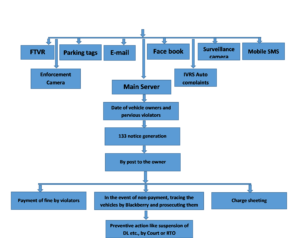
How 133 notices are served and compounded
Notices are served through post and sometimes they are served through the police personnel. If the owner of the vehicle pays the fine it gets deleted in the server. If not, it comes up in the Blackberry handset of traffic officer. If the owner wants to clear the pending fine he can do so by any of the following methods;
- Payment at any traffic police station
- Payment through any traffic ASI, PSI, PI in the field
- Automation enforcement Center / TMC
Implementation Strategy:
In order to implement Automated Traffic Challaning System in a city with a population of one million, the following deliverables are required:-
- Database server and its connectivity with Transport Department server
- 100 Nos. hand-held enforcement devices along with Bluetooth enabled printers
- Back-end connectivity between handheld devices and database server through a service provider.
- 50 Nos. surveillance cameras with connectivity to Traffic Management Center
- 4 Nos. Enforcement cameras with connectivity to Traffic Management Center
- 200 Nos. digital cameras with online connectivity facility through a service provider to data base server.
- Printed blank challans for generating notices under Section 133 of IMV Act.
- 75 Nos. Traffic Police Officers of and above the rank of Assistant Sub-Inspectors of Police.
- 250 Nos. Head Constables / Police Constables
- Computer trained Police constables to man Traffic Management Center and Automation Center
System Architecture
Traffic Enforcement System Architecture
- The solution enables traffic field personnel to access the backend infrastructure through a mobile handheld device with ease in a high secured manner
- The handheld application will have the capability to print data from the screen on a Bluetooth/Wi-Fi enabled printer
- Push technology for data transfer. ‘Always ON feature’
Network Architecture
- The handheld devices with application will be using mobile packet data network (GPRS/EDGE/3G/4G) to reach the servers placed at State Data Center
- The application sitting on the handheld enables the officers to collect fines online
- In case of any network issues or server related issues, the data gets stored on the handheld and gets uploaded to the server automatically once the network connectivity is restored
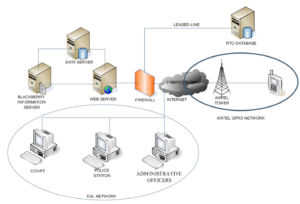
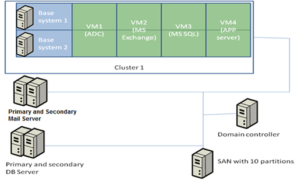
Server architecture:
- Redundant infrastructure with high availability
- Application Servers
- Data Base Servers
- Mail Servers
- Storage
Features of the Enforcement Application Software:
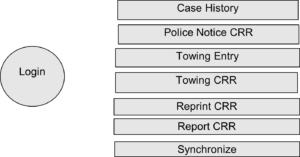
Process Flow Diagram
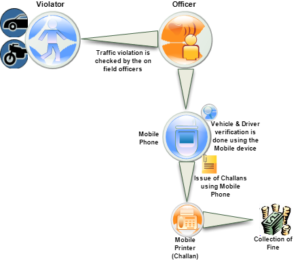
Typical Management Information System Reports:
Reports will be provided to senior officers to monitor the activities. Web reports will be provided with the login and password to protect the data from unauthorized access. A hierarchy based MIS report sub-modules can be designed as per the state police requirement.
Following are the reports that are generated for MIS purposes:
- Vehicle-wise offences daily/monthly or weekly reports
- Police station-wise offences
- Station-wise case booked report
- Station-wise amount collection report
- Station-wise issue of police notice and ON THE SPOT FINE
- Station-wise Charge sheet generation report
- Officer-wise case booked and fine amount collected report
- Subdivision-wise reports
- Report on cases booked and fine collected report
- Report of Cancellation of licenses
- Suspension & revocation for permit
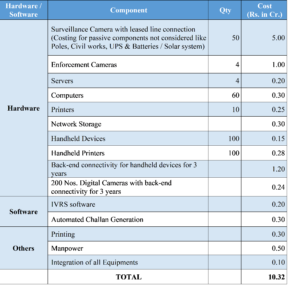
Financial Implication:
In a city of one million population the financial implication will be as follows;
Conclusion:
Bangalore Traffic Police under B-Trac project has already implemented Automated Traffic Challaning System from the year 2003. Some other cities also had initiated Automated Enforcement in a limited way. On an average Bangalore Traffic Police books around 8000 traffic violation cases through cameras and another 8000 through hand held Blackberry devices. Bangalore Traffic Police have booked over 7.4 million cases against traffic violations in the year 2014 and have collected a fine amount of Rs. 65 crores during the same period. Bangalore Traffic Police is presently using 5 Enforcement Cameras, 175 Surveillance Cameras and around 500 digital cameras for online booking of cases. This system has brought dividends for Bangalore Traffic Police in the form of greater transparency and effective enforcement of traffic laws. Apart from this, the ready availability of data on past violations has enabled Bangalore Traffic Police to send 4587 driving licenses for suspension.
Since September 2013, Mysore Police has generated 4,50,000 notices against violations of traffic rules through automation enforcement. Bengaluru Traffic Police generates more than 20 lakh notices each year. Automated Traffic Challaning System can be adopted in other Indian cities and can be used as effective e-governance tool in managing and monitoring traffic related issues in various cities and towns across the country.
The Automated Traffic Challaning System is a revenue generating model. The initial investment of Rs. 10.32 Crores for a city of one million population can be recouped within one year. This is due to fine amount collected from violators of traffic rules through Automated Traffic Challaning System. Therefore, entire system is self-sustaining and does not require any funds for expansion. The State Governments should consider to provide all the fine amounts collected to police for expansion of the programme within the city.