Traffic management problems which are assuming alarming proportions in the cities of the industrially advanced countries are being experienced in the Indian cities too. They have reached a critical point strangulating the cities. Due to increased congestion and consequent delays the mobility of the traffic is affected and the city is becoming more liability than an asset. From the point of view of Road safety the conditions in the cities are far from satisfactory. The situation has arisen largely owing to an inadequate appreciation of the nature and type of a whole range of problems. Some of the significant problems leading to traffic congestion in Indian cities are;
- rising demand for travel due to increase in population and other activities;
- concentration of land use in certain areas such as central business districts and office areas;
- mixed nature of traffic;
- inadequate facilities segregating slow traffic;
- insufficient road space;
- inadequate width of pedestrian sidewalks and their encroachment by hawkers;
- inadequate facilities to meet the heavy demand for parking requirements;
- lack of road sense and indiscipline on the part of road users;
- ineffective enforcement measures;
- inadequate funds to meet the increasing demand for essential improvements; and
- non existence of a specific organization with specialized personnel to deal with traffic problems.
The above problems have largely contributed to huge traffic congestion in almost all Indian cities. Though majority of traffic problems is due to faulty urban planning by civic agencies, traffic police is most often blamed for chaotic traffic situation. In order to improve traffic situation and bring effective traffic regulation through use of technology, the Bangalore Traffic Police has initiated a unique project called ‘B-TRAC’.
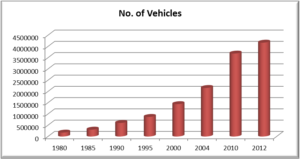
Bangalore is one of the premier cities in India having a population of nearly 10 million and vehicle population of about 4.2 million. It is a city which has registered a growth of more than 4% year-over-year during the last 2 decades and is still growing on at even faster rate.
Bangalore Traffic Police looks after the regulation and enforcement aspects of traffic management in the city. It manages traffic on 11000 Kms of network and nearly 40,000 intersections. The geographical coverage of Bangalore Traffic Police is 1005 Sq.Kms. The sanctioned strength of Bangalore Traffic Police is 3260 and is supplemented by 500 Home Guards.
The growth of vehicles in Bangalore City is shown in the table below.

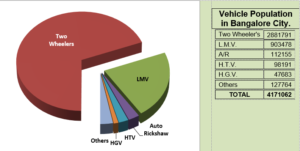
The following graph indicates different types of vehicles registered in Bangalore City.
Types of Vehicles registered in Bangalore City.
Phenomenal growth of population and number of vehicles registered in Bangalore City and the obstruction of carriage way by number of on-going works like Metro fly-overs, under-passes, over-bridges, the management of the traffic and ensuring smooth flow of the traffic has become a herculean task. In this background Bangalore Traffic Improvement Plan which is popularly known as B-TRAC was envisaged.
The scheme was started in the year 2006-07 and the annual grants given by the Government for implementation of this project are as follows:
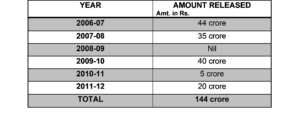
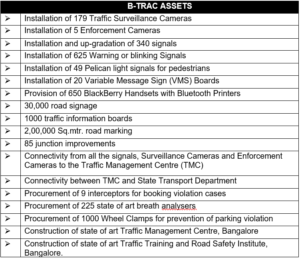
Though the Government had released funds from the financial year 2006-07, the implementation of the project started in the year 2007-08. The assets created under B-TRAC project are as follows:
Bangalore City Traffic Police realizes that ever increasing expectations of citizens cannot be met by increasing the manpower alone. That is why there is a need for paradigm shift from manual regulation to technology driven traffic management plan. The core philosophy behind B-TRAC plan is:
-
- Creating a reliable real-time traffic information system.
- Analyzing such information and utilizing the traffic intelligence thus generated for ensuring better traffic management and planning.
- Disseminating such information to public in real time for enabling them to make informed choices on the roads.
The Components of B-TRAC are:
- Centrally Controlled Traffic Signaling System
The Centrally Controlled Traffic Signalling System comprises of the following;
a. Automated Signaling System
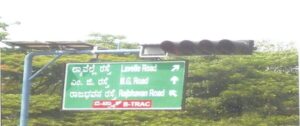
Automated signaling is a concept wherein all the signals placed at various junctions of the city are centrally controlled from a Central Hub. Traffic signal at each junction is connected to a controller, which in turn is connected to Traffic Management Centre (TMC) using leased line. These controllers are intelligent and can be programmed to perform as per the requirements of specific location and time. Some of the visible benefits are:
-
- Centralized manipulation and monitoring of the traffic signals like timing and patters on short-term or long term basis using state-of-art and innovative application software.
-
- Pre-programming of signal controllers at junctions with different phase/cycle times, in each direction, at different points of the time during a day and different days during a week. This is extremely helpful for handling peak hour and non-peak hour situations at junctions using different approaches. At present each signal in city has at least 4 to 5 programs. There is different time cycle for Saturdays and Sundays.
b. Vehicle Actuation
An underlying sensor (also referred to as loop) embedded below the asphalted road near the zebra crossing, senses the vehicles passing over it. The sensor is linked to a controller placed at the junction, which sends signals indicating presence or absence of vehicle over it. Every direction is allotted a minimum 9-second phase time to begin with. As long as vehicles are present on the loop, 4 seconds will continue to be added in the phase time i.e. 9,13,17 and so on, subject to an upper limit. In case of no vehicle passes for more than 4 seconds, the controller turns the signal red even if allocated green time is still unutilized. Hence, wastage of green time is avoided and traffic from other direction is released. As a result of this technology, a total cycle time in each cycle will vary according to traffic flow.
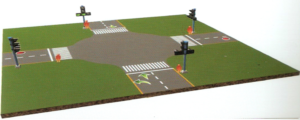
Vehicle actuation avoids wastage of green time and encourages discipline by reducing signal jumping offences. The maximum benefits of vehicle actuation are experienced during lean hours and at junctions where different directions have different traffic densities.
During peak hours, when there is over saturation in all the directions, vehicles actuated signal functions like fixed-time signal.
c. Signal Progression
This programme ensures that each junction turns green towards a priority direction in conjunction with its previous signal, in the same direction, but with a time traffic from a junction reaches the next junction it finds green signal awaiting them thus ensuring minimal wait at signals. The only short coming is that the time difference is manually fed and any modification of green time at a particular junction, participating in signal progression, can adversely affect the system. Moreover, signal progression works on the presumption of no non-signalized right turns in the corridor and an assumed average speed for all the vehicles. This concept is very useful for closely placed signals.
d. Area Traffic Control (ATC)
This concept is a combination of signal progression and vehicle actuation. In ATC, two sets of activities are conducted, namely;
- Optimization of green time allotted to each direction at each junction. A fixed time is allocated at each junction controller for each direction. This time is validated against the traffic passing in these directions; if it is observed that the entire allocated green time for a particular direction is not utilized then the green time in that direction is reduced by 10%. This activity is repeated till the optimum green time is achieved for each direction in all the junctions in the area or the corridor. In the entire process the embedded loops at junctions play an important role in detecting vehicles passing towards particular direction.
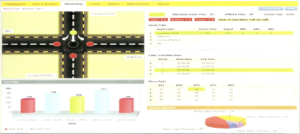
This information is processed by the controller placed at each junction and is passed to the central server placed at TMC, where an algorithm takes decision on green time optimization.
2. Alignment of each junction with one another so that signal progression can be implemented across a series of junctions falling in a priority direction.
Such green time optimization happens all through the day. This change of time can cause the alignment between adjacent junctions, part of signal progression to break. As such software running on a server at the central TMC automatically prevents such break up between these junctions so that vehicle actuation and signal progression work simultaneously.
e. Power Backup and Management At Junctions
The traffic junctions in the city of Bangalore are now equipped with high-end equipment with required uninterrupted power supply (UPS). The traffic police department has drawn up an elaborate arrangement, which ensures that power at each junction is uninterrupted. This plan is implemented using two levels:-
-
- Main power supply is provided to traffic signals using solar panels while networking devices and cameras are energized using BESCOM connections.
- The main power input is fed into an UPS, one each for networking devices, traffic signals and cameras, which provide a backup support for about 4 hours.
2. Enforcement Camera System
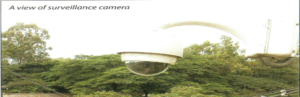
High resolution cameras placed at various junctions are meant to capture pictures of vehicles over speeding or jumping signals. These cameras are connected to central server kept at TMC using 4 Mbps leased lines. The central server also has the capability to interpret the number plates using alpha numeric character recognition software. This registration number is matched with transport department database for generating notices to violators.
3. Surveillance Camera System
180 junctions across the city of Bangalore are fitted with Pan-Tilt-Zoom cameras, capable of capturing live feeds and pass on them to the TMC where a 24-Terabyte storage solution is used to store the feed for a period of 15 days. The live feeds have their own strategic importance in regulating traffic as well as designing of traffic signals based on actual vehicle counts. Soon video analytics will be used to intelligently interpret these feeds.
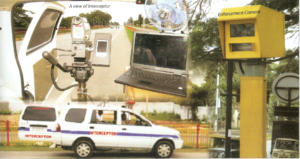
4. Speed Interceptors
Realizing that it is not possible to have video surveillance for every junction or locations between the junctions, police has deployed nine-interceptor vehicles equipped with surveillance camera, laser speed gun and alcometer for recording the violation and prosecuting the offenders while on move.
5. Automated Enforcement System
Automated enforcement also known as contact less system of booking of traffic violations was initiated in the year 2003. In this system violations recorded through digital cameras and enforcement cameras are processed at Central Automation Centre and notices are sent to the owners of the vehicles involved in traffic violations. This is a highly transparent method of booking of cases against the traffic violators.
Bangalore Traffic Police has tied up with Bangalore-One, a citizen-friendly initiative of e-Governance department, for enabling anywhere, anytime payment of the fines imposed. Citizens can settle the violation tickets issued against their names as well as parking violation tags issued to them by visiting any Bangalore-One centre or any traffic police station.
These places are connected using a dedicated network to the central application server kept at State Data Center (SDC). Citizens can also pay their traffic violation notices and parking violation tickets online through traffic police website from the comforts of their home.
6. Blackberry driven Enforcement
Traffic Police has equipped its officers with handheld BlackBerry devices connected to Bluetooth-enabled printers. These devices are connected to a central server kept at State Data Center (SDC).
BlackBerry wielding officers enforce traffic rules and regulations and fine offenders. All these activities are done online resulting in real time monitoring and statistical analysis for the senior officers’ review.

Online booking of violations using BlackBerry also ensures tracking of habitual traffic offenders thus ensuring enhanced punishment for them. In addition, it also tracks down unpaid violation notices issued in past.
7. Traffic Scan through GPS
600 BMTC busses running in Bangalore city are fitted with GPS devices. This facility is used to identify congestion across the roads of Bangalore and a real time GIS reporting mechanism projects the data thus collected into a map of the city. The time taken to travel between two locations of the city at a non-peak hour is taken as base time and any deviation from that is used to identify three basic traffic patterns, namely, heavy traffic (red) medium congestion (orange) and free flowing traffic (green).
8. Traffic Scan through Mobile Density
A supplementary mechanism of identifying congestion is by using density of mobile devices currently existing under a particular mobile tower. This value is processed for identifying the level of congestion at a particular junction and subsequently the processed data is used to create a real time GIS enabled map at TMC. The higher the number of mobile devices under a particular tower the more likely is the chance for congestion. The only weak point is this mechanism is that the system is capable of identifying congestion at the round junctions only.
9. Variable Messaging Systems
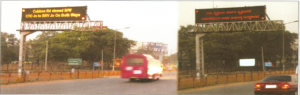
Message boards mounted on large gantries are being placed at convenient locations of the city for displaying traffic related information. This information is fed into terminals placed at TMC from where the message is relayed on to the boards using radio frequency waves. The information displayed informs the travelers about existing traffic scenario to help them avoiding traffic snarls and making informed choices.
10. Parking Information System
All major parking places in the city of Bangalore, which are computerized are proposed to be connected to the TMC using web based services. The real time parking availability status from these parking places will be relayed to the traffic Police web site and made accessible to the citizens through VMS board and phones using SMS on need to know basis
11. Multi-phased public interaction
-
- Facebook: In order to interact with public and to address their traffic related complaints and valuable suggestions, a platform is created by opening an account in facebook a social networking website. More than 31,000 people have already subscribed to this as on March 2012.
-
- SMS Alerts: BTP is also sending free traffic alerts to its subscribers regarding traffic situation. Anyone can subscribe to the service by sending SMS JOIN<space>BTP to 09219592195. As on March 2012 more than 21,000 people have subscribed to this facility.
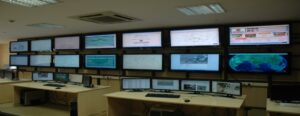
IMPACT OF B-TRAC PROJECT
B-TRAC 2010 is the first of its kind project in the Country to address the issues of traffic congestion, safety etc by utilizing the latest traffic management technology and techniques, which are appropriate to our context. This will give the much-needed scope for larger infrastructure projects to be planned and implemented for improving the transportation system in Bangalore city.
Implementation of B-TRAC project has resulted in improvement in traffic regulation, enforcement and reduction in road accidents. The impact can be seen under the following heads;
-
- Transparency in enforcement of traffic rules:
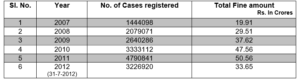
Replacing the paper based challan system with automated enforcement and BlackBerry based challaning system has brought in lot of transparency in booking of cases against violators of traffic rules. Permanent records are created for traffic violations through automated enforcement. Automated enforcement has helped in identifying the repeat offenders. The new system has resulted in increased number of registration of cases and an increase in collection of traffic fines, as appearing from the following table:
-
- Substantial compliance of Traffic laws and rules
The use of surveillance camera, enforcement camera, field traffic violation report (FTVR) and breath analyzer to identify and prosecute drunk drivers/riders, has brought in greater discipline among the road users. Identification of repeat offenders has resulted in suspension of 3101 driving licences during the current year.
-
- Reduction in road accidents
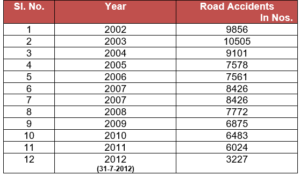
One of the important achievements of B-TRAC project is reduction in number of road accidents. Accident Scenario has seen a positive change and severity of the accidents has come down due to strict automated enforcement. The reduction in number of accidents is shown in the table below:
-
- Reduction in traffic congestion in central areas
The topography of Bangalore city is typically full of crossroads. Handling the cross traffic is difficult, but this task is also being managed efficiently. It is for these very reasons around 190 roads were made one-ways in phases, and chaos in traffic has reduced to a great level and conflict points were resolved to a greater extent thus easing the traffic flow.
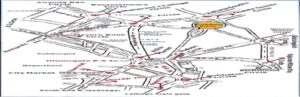
Map showing One-way Roads
-
- Reduced travel time due to scientific fine-tuning of signal timings at junctions
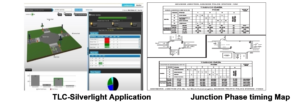
Average savings in green time by using customized traffic light configuration system
-
- Reduced Journey time due to Signal synchronization
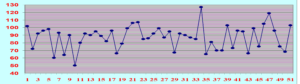
The average journey speed has increased from 18 Kmph to 23 Kmph in the city after the implementation of B-TRAC project. This is largely due to synchronization of signal lights on 10 important traffic corridors. Synchronization coupled with central control of traffic signal lights has resulted in faster flow of traffic and increase in average speed.
CONCLUSION
The initiative has started yielding results from the first day itself. The changes and the impact were dramatic and exceeded the expectations of the department. Here it is essential to state that the objective of the entire exercise was not to increase the revenue collections but to enhance the quality of traffic enforcement & traffic management by ensuring that violations are recorded and violators are penalized as well as traffic accidents are reduced.
The B-TRAC project was recognized by Government of India and Bangalore Traffic Police have received the following awards for its implementation.
- National Award for Best use of Information and Communication Technology (ICT) by the Dept of Personnel and Training (DoPT), Government of India in the year 2011.
- Award for Excellence by Ministry of Urban Development, Government of India in the year 2011.
- Golden Peacock Award for Innovative products / Services award -2012.
It is seen that many components of B-TRAC project like Automated Enforcement, e-challaning system etc are being implemented in many cities across India. In order to implement the project, the financial support from the concerned State Government is essential. Therefore it is recommended that traffic police organizations of important cities can implement this innovative scheme to bring greater efficiency in traffic regulation and enforcement. The systematical implementation of sustainable components of B-TRAC project will result in making our towns and cities more livable.