Road traffic injuries are a major public health problem and a leading cause of death and injury around the world. Each year nearly 1.2 million people die as a result of road crashes, and millions more are injured or disabled. This number is higher than deaths due to natural calamities or any contagious disease. Most of the victims of road accidents are vulnerable road users like pedestrians, cyclists and two wheeler riders. In most cases, people killed and injured are men in the age group of 15-45 years which is known as productive age in any economy. The death results in loss of precious human resources in the country and total disaster for the families of the victims.
Pedestrians are the most vulnerable road users. They account for more than 25% of road accident deaths and injuries in India. Pedestrian deaths and injuries are often preventable and yet their safety does not attract the attention it merits. Police has an important role in prevention of pedestrian related accidents. In order to take effective measures to safeguard pedestrians it is important to understand the causes, ramifications and possible sustainable strategies to prevent pedestrian related death and injuries.
Pedestrian as a road user
Walking is a basic and significant mode of transport and all human beings are pedestrians for varying time periods on roads. Right from the early childhood – till the person is unable to move, walking remains an important mode of travel. It is a well-established fact that walking has health and environmental benefits. Walking is found to be healthy and it helps in prevention and control of some non communicable diseases like diabetes, obesity, hyper tension, cardiac problems and others. Walking also contributes to reducing vehicular traffic, resulting in reduction of air and noise pollution. Due to these benefits urban traffic planners in big cities encourage walking and non-motorized transport to reduce traffic congestion.
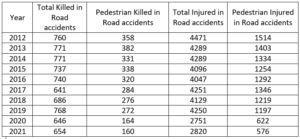
In Indian cities, unlike any other road users, pedestrians are at a higher risk of injury due to lack of pedestrian facilities and indiscipline among road users. More than half of the people killed on roads in Indian cities each year are pedestrians. In Bengaluru city, the pedestrians killed are generally more than 40% of the total persons killed in road accidents. The following table illustrates the same:
Table: Pedestrians killed and injured in Bengaluru city for the last 10 years
Factors responsible for road accidents involving pedestrian:
The major reasons for the relatively high volume of accidents involving pedestrians on Indian roads can be attributed to the following factors:
- Over speeding:
The speed at which a vehicle is travelling influences both accident risk and accident consequences. The effect on accident risk comes mainly via the relationship between speed and stopping distance. The higher the speed of a vehicle, the shorter the time a driver has to stop and avoid a crash, including hitting a pedestrian. Considering the time needed for the driver to react to an emergency and apply the brakes, a car travelling at 50 km/h will typically require 36 metres to stop, while a car travelling at 40 km/h will stop in 27 metres.
If a car is travelling unusually fast, other road users such as a pedestrian waiting to cross the road may misjudge the speed of the approaching vehicle. The pedestrian may mistakenly assume it is safe to cross the road, attempt to do so and get struck by the vehicle.
- Drinking and driving:
Alcohol consumption results in mental impairment, which increases the likelihood of an accident because it produces poor judgement, increases reaction time, lowers vigilance and decreases visual acuity. It is important to note that alcohol impairment as risk factor is not limited to drivers of vehicles but is also important for pedestrians. Like motor vehicle drivers, a pedestrian’s risk of crash involvement increases with increasing blood alcohol content.
- Lack of pedestrian facilities in roadway design and land use planning:
Pedestrian risk is increased when roadway design and land-use planning fail to plan and provide facilities such as sidewalks or adequate consideration of pedestrian access at intersection. Infrastructure facilities and traffic control mechanisms that separate pedestrians from motor vehicles and enable pedestrians to cross roads safely are important to ensure pedestrian safety, complementing vehicle speed and road system management.
- Inadequate visibility of pedestrians:
The issue of pedestrians not being properly visible is frequently cited in literature as a risk for pedestrian injury. Inadequate visibility of pedestrians arises from:
-
-
- Inadequate, or lack of, roadway lighting.
- Vehicles and bicycles not equipped with lights.
- Pedestrians not wearing reflective accessories or brightly coloured clothes especially at night and at dawn or dusk.
- Pedestrians sharing road space with fast-moving vehicles.
-
- Other causes:
Several other factors that contribute to pedestrian injury include:
-
-
- Inadequate enforcement of traffic laws.
- Unsafe driving practices.
- Driver distraction, including mobile phone use.
- Driver fatigue.
- Pedestrian-vehicle conflict at pedestrian crossing points.
- Reduced reaction time and reduced walking speed for the elderly.
- Inability of children to gauge vehicle speed and other relevant information in order to cross the street safely.
- Lack of supervision of children who are too young to make safe judgements.
- Pedestrian distraction, including mobile phone use.
- Attitudes of drivers and pedestrians.
- Failure of drivers to respect right-of-way for pedestrians, including failure to yield at pedestrian crossings.
-
SUSTAINABLE STRATEGIES TO ENHANCE PEDESTRIAN SAFETY
Safety on road is a fundamental right of every citizens, among all the road users, pedestrians should be given priority and traffic planners and police should make all out efforts to provide adequate pedestrian safety facilities in the city. Pedestrian safety can be enhanced through the following engineering, enforcement and educational strategies:
- Reducing pedestrian exposure to vehicular traffic:
There are several specific engineering measures that reduce pedestrian exposure to vehicular traffic. Most of these measures involve separating pedestrians from vehicles or reducing traffic volume.
-
-
- Sidewalks/footpaths: Sidewalks separate pedestrians from motorized vehicles as well as bicycles. They provide space for different types of pedestrians to walk, run, play, meet and talk.
- Marked crossings: Crossings separate pedestrians from vehicular traffic for a brief time period while they cross the street. The purpose of a marked crossing is to indicate the optimal or preferred location for pedestrians to cross. Marked crossings help to indicate pedestrian right-of way and motorists need to yield to pedestrians at these points.
- Overpasses and underpasses: Pedestrian overpasses and underpasses are bridges and tunnels that allow for uninterrupted flow that is separate from vehicular traffic. This measure is used primarily in areas with high pedestrian volumes.
- Mass transport routes: Pedestrian safety is a key issue to consider in the design of any mass transport system, including routes and stops. Mass transport routes are usually located on major arterial roads, which are the most dangerous types of urban streets. Though travelling by public transport may be one of the safest modes, transit passengers are at a high risk of crashes when walking to and from the station or stop.
-
- Reducing vehicle speeds:
One of the most effective ways to improve pedestrian safety is to reduce the speed of vehicle. If possible, speed management measures should be used alongside measures to reduce pedestrian exposure to vehicular traffic. Speed management is much more than setting and enforcing appropriate speed limits. It employs a range of measures in engineering, enforcement and education with aim of balancing safety and efficient vehicle speed on the road network.
- Improving the visibility of pedestrians:
A high percentage of pedestrian collisions and deaths occur when lighting conditions are low. There are several engineering and behavioural measures that makes pedestrians more visible to motorists, especially during dusk, dawn, and at night. These measures include:
-
- Providing crossing enhancements such as raised crossing islands and traffic signals.
- Implementing lighting and/or crossing illumination measures. Increasing intensity of roadway lighting increase visibility of pedestrians at night especially at pedestrian crossings.
- Removing or repositioning physical objects that affect visibility, such as trees and billboards that make it difficult for drivers to see pedestrians.
- Installing signals to alert motorists that pedestrians might be crossing. Pedestrian activated signals may be appropriate at locations with sporadic pedestrian traffic.
- Improving pedestrian and motorist safety awareness and behavior:
Changing the attitudes and behaviors of drivers and pedestrians is a complex, long-term undertaking that requires a variety of interventions to be implemented.
- Educations, outreach and training: Safe road-user behaviour and a reduction in pedestrian fatalities depend not only on knowledge and skills but also on community support, perception of vulnerability and risk, social norms and models, engineering measures and law enforcement.
Road safety educational program may include the following:
-
- Raising awareness: This can include informing drivers about care, prudence, kindness, consideration, speed, pedestrian right-of way and traffic rules.
- School-based education: Such programs help children acquire the knowledge and skills for pedestrian safety.
2. Mass media campaigns: These can be used to inform the public about pedestrian safety legislation, risk factors, impact of collisions and solutions available. Targeted and planned mass media and social marketing campaigns informing the public about pedestrian safety laws and risk factors are necessary to improve driver and pedestrian behaviour and enhance understanding of traffic issues such as traffic signs and right-of-ways for all road users.
- Traffic law enforcement:
Traffic laws affecting pedestrian safety are largely aimed at controlling pedestrian and driver behaviour at intersections, crossing and other locations. Comprehensive legislation is a key element of pedestrian safety, but legislation alone is not likely to facilitate behaviour change in the absence of law enforcement and adequate penalties.
Overspeeding and Drunken driving are generally considered as greater risk for pedestrian safety. Therefore law enforcement agencies should concentrate on these two violations to ensure pedestrian safety;
a. Overspeeding:
There are many reasons for over speeding. Generally, young people indulge in fun and pleasure by over speeding while driving a vehicle. For many youngsters it is a thrilling experience. Sometimes, people who have deadlines try to cover distances in shorter period of time. In many congested roads, especially in Bengaluru city, people over-speed and even dangerously over-take from both sides of the road, leading to road accidents.
In order to prevent fatalities on roads, there is a need to adopt sustainable engineering, enforcement and education strategies to manage speed on roads. Some of these strategies are:
-
-
-
- Speed limits should be fixed scientifically for different categories of roads depending on different functions of the road and its usage by various road users.
- While designing and developing roads, appropriate safeguards for vulnerable road users like pedestrians, cyclists and two wheeler riders should be incorporated.
-
-
-
-
-
- Appropriate visible signages needs to be erected for better information of road users.
-
-
-
-
-
- Installation of speed governors for all public transport vehicles and goods vehicles should be made mandatory at the manufacturing stage itself.
- Automatic speed enforcement devices such as speed cameras and speed interceptors should be deployed by enforcement agencies on all highways and city roads.
- Stringent penalties like cancellation of driving licences should be incorporated in the penal laws.
-
-
-
-
-
- Increased public awareness and improving compliance towards speed restrictions needs to be given importance through campaigns and public education programs.
-
-
b. Drunken Driving:
One of the major causes of road accidents is drunken driving. The risk of being involved in a road accident is higher in case of drivers who consume alcohol even in small amounts and drive their vehicle. A person under the influence of alcohol can not only injure themselves, but can injure or kill others as well. Accidents by a drunken driver are generally due to poor judgement, slow reaction, delayed reflexes, poor visual attention, improper co-ordination and difficulty in identifying road bottlenecks. Consumption of alcohol also results in a euphoric effect which makes an individual shed their inhibitions resulting in the person tending to violate traffic safety rules.
According to World Health Organization (WHO), in most high-income countries, about 20% of fatally injured drivers had excess alcohol in their blood i.e. blood alcohol concentration (BAC) in excess of the legal limit. In contrast, studies in low and middle income countries have shown that between 33% and 69% of fatally injured drivers and between 8% and 29% of non-fatally injured drivers had consumed alcohol before their crash.
In the years to come, alcohol use and driving will be a major problem due to rapid motorization, increase in availability of alcohol and rising income levels of people. There is a need to evolve effective measures to control drunken driving and save human lives.
Severe and stringent punishment for drunken drivers will be an effective deterrence. According to Sec 185 of Central Motor Vehicles Act, 1988, “Driving by a drunken person or by a person under the influence of drugs, whoever, while driving, or attempting to drive a motor vehicle, (a) has, in his blood, alcohol exceeding 30 mg per 100 ml of blood detected in a test by a breathalyzer or (b) is under this influence of a drug to such an extent as to be incapable of exercising proper control over the vehicle, shall be punishable for the first offence with imprisonment for a term which may extend to six months, or with fine which may extend to two thousand rupees, or with both: and for a second or subsequent offence, if committed within three years of the commission of the previous similar offence, with imprisonment for a term which may extend to two years, or with fine which may extend to three thousand rupees or with both”.
The above punishment is not stringent compared to the enormous damage a drunken driver can inflict on themselves or another person(s). Therefore, this section should be amended to provide for greater punishment.
Cancellation of driving licence, confiscation of vehicle and vehicle registration cancellations are some of the suggested detrimental punishments for drunken driving.
Alcohol-impaired drivers and pedestrians create injury risks for themselves and other road users. Strict legislation and complementary activities that can help reduce pedestrian road traffic injuries related to alcohol include the following:
-
-
-
- Conducting mass media campaigns on drinking and driving, including informing the public about drinking and driving regulations and penalties.
- Setting and enforcing BAC limits for the general driving population and lower limits for young and inexperienced drivers.
- Enforcing BAC limits through random breath testing and sobriety checks and implementing penalties for offenders.
- Enforcing laws on being drunk in public places, which will cover drivers, pedestrians and other members of the public.
- Rehabilitating high-risk offenders, that is, those with BAC levels in excess of permissible limits.
-
-
- Improving vehicle design for pedestrian protection:
Motor vehicles have become increasingly safer for occupants, due to improvements in vehicle design. Until recently, vehicle design incorporated few features to protect pedestrians, but there is an increasing effort to include design elements that reduce the likelihood of pedestrian collision and/or reduce the severity of pedestrian injury in the event that a vehicle-pedestrian crash does occur.
- Providing care for injured pedestrians:
The primary goal in pedestrian safety should be to prevent road crashes from happening in the first place. However, pedestrians do get injured, despite the best efforts and intentions. An efficient post-crash care response can minimize the consequences of serious injury, including long-term morbidity or mortality. Pedestrians struck by motor vehicles with high energy transfer end up with high residual locomotion disability and also have significantly higher mortality rates than occupants of vehicles.
- Rehabilitation of Injured Pedestrians:
For every person who dies in pedestrian related accidents, many more are left with permanent disabilities. Rehabilitation services are an essential component of the comprehensive package of initial and post hospital care of the injured. They help to minimize future functional disabilities and restore the injured person to an active life within society. The importance of early rehabilitation has been proved, though best practices in treatment programs have yet to be identified. Most countries need to increase the capacity of their health care systems to provide adequate rehabilitation to survivors of pedestrian related accidents.
CONCLUSION:
In India, with its huge population and most of them being pedestrians (even vehicle owners become pedestrians depending on the length and purpose of travel), safe road environments are very essential. Safe facilities for walking and crossing the road should be provided that will be used maximally by all people. Pedestrians should simultaneously be educated to use these facilities for their safety. Necessary blending of the two should be done with legislation and enforcement strategies. Better traffic management, increased visibility and speed control strategies will further enhance safety of people on roads. Undoubtedly, safety on roads is the fundamental right of every citizen.
The role of the police and other enforcement agencies is vital in implementing the above-mentioned strategies. Strict enforcement of traffic rules and disciplining pedestrian through penalties for jaywalking will go a long way in making our roads safe for pedestrians.
References:
- Srinivasan, N.S., Road and Traffic Engineering improvements for road safety, International Seminar on Road Safety6, Srinagar, IRC, 1986.
- Towards Safer Roads in Developing Countries – Transport Research Laboratory (TRC) U.K. 1991
- Practical Guide on Road Safety – Global Road Safety Partnership, Geneva 2007
- M. A. Saleem IPS, Traffic Management in Metropolitan Cities “A framework to provide sustainable strategies to overcome traffic congestion and ensure greater safety on roads”, Puliani and Puliani, 2019, Bengaluru.
- Sri D Sanyal – Planning Pedestrian facilities in the Urban environment – Urban Transport Journal Vol.8, Dec 2007
- Road Traffic Injury Prevention in India – World Health Organization and National Institute of Mental Health and Neurosciences, Bangalore – 2004-05.
- G Gururaj, Bengaluru, Injury/Road Traffic Injury Surveillance Programme, NIMHANS, Bangalore.