Over a million people are killed every year due to road accidents across the globe. In India alone nearly one hundred thousand people lose their lives as a result of road crashes. This number is higher than deaths due to natural calamities or any contagious disease. Most of the victims of road accidents are vulnerable to road users like pedestrians, cyclists and two wheeler riders.
In most cases, people killed and injured are men in the age group of 15-45 years which is known as productive age in any economy. The death results in loss of precious human resources in the country and total disaster for the families of the victims.
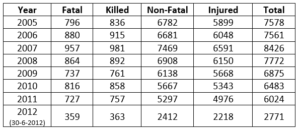
In Bangalore city, 757 persons lost their lives and 4976 were injured due to road accidents in the year 2011. The following table indicates different categories of victims of road accidents in the year 2011-12.
Statement showing the number of fatal and Non-fatal cases reported, persons killed and injured during the year 2005-2012 (upto 30-06-2012).
One of the major causes of road accidents is drunken driving. The risk of being involved in a road accident is higher in case of drivers who consume alcohol even in small amount and drive their vehicle. A person under the influence of alcohol can not only injure himself, but can injure or kill others as well. The accidents by a drunken driver is generally due to poor judgement, slow reaction, delayed reflexes, poor visual attention, improper co-ordination and difficulty in identifying road bottlenecks. Consumption of alcohol also results in euphoric effect which makes an individual shed his inhibitions and the person tends to violate traffic safety rules.
Available data on road accidents indicate that one-third of accidents occur during night which is generally due to drunken driving. Recognizing this aspect, almost every nation has anti-drunken driving laws in place. These laws describe the acceptable level of alcohol consumption which driving. In India, alcohol beyond 30 mg per 100 ml of blood is considered as violation.
According to World Health Organization (WHO), in most high income countries, about 20% of fatally injured drivers have excess alcohol in their blood i.e., blood alcohol concentration (BAC) in excess of the legal limit. In contract, studies in low and middle income countries have shown that between 33% and 69% of fatally injured drivers and between 8% and 29% of non-fatally injured drivers had consumed alcohol before their crash (i).
In years to come, alcohol use and driving will be a major problem due to rapid motorization, increase in availability of alcohol and rising income levels of people. There is a need to evolve effective measures to control drunken driving and save previous human lives.
The following measures should be undertaken to curb drunken driving and reduce road accidents:
- Deterrent Punishment for drunken drivers:
Severe and stringent punishment for drunken drivers will be an effective deterrence. According to Sec 185 of Central Motor Vehicles Act, 1988, “Driving by a drunken person or by a person under the influence of drugs, whoever, while driving, or attempting to drive a motor vehicle, (a) has, in his blood, alcohol exceeding 30 mg per 100 ml of blood detected in a test by a breathalyzer or (b) is under this influence of a drug to such an extent as to be incapable of exercising proper control over the vehicle, shall be punishable for the first offence with imprisonment for a term which may extend to six months, or with fine which may extend to two thousand rupees, or with both: and for a second or subsequent offence, if committed within three years of the commission of the previous similar offence, with imprisonment for a term which may extend to two years, or with fine which may extend to three thousand rupees or with both”.
The above punishment is not so stringent compared with the enormous damage a drunken driver can inflict on himself or other person/s. Therefore, this Section should be amended to provide for greater punishment.
Cancellation of Driving licence, confiscation of vehicle and vehicle registration cancellations are some of the suggested detrimental punishments for drunken driving.
- Mass Media Campaigns:
Enforcement of anti0drinking laws will be more effective when accompanied by mass campaigns against drunken driving. The campaign should aim at:
- Making people aware of the risk of arrest and its consequences;
- Making drink and drive laws publicly acceptable;
- Raising the acceptability of Police enforcement.
A carefully planned and well executed campaign against drunken driving by reaching sufficiently large audience is effective in reducing drunken driving. Endorsement by leading personalities like film artists, sports persons etc., can bring glamour into the campaign and the message can be effectively communicated to the masses.
- Compulsory check of drivers of commercial vehicles:
Drivers of commercial vehicles who perform duties for long hours generally take to drinking alcohol to reduce stress. The normal pattern of work of commercial drivers is influenced by strong economic and social forces. Argument about the safety is usually ignored in many places. It is important that drivers of commercial vehicles, especially, passenger transport vehicles should be checked before and after their duty hours. Karnataka State Road Transport Corporation (KSRTC), a leading passenger transport organization in Karnataka had evolved a new mechanism of testing of the drivers between 1 am and 3 am on all major highways. Such measures will definitely have a huge impact in curbing drunken driving. Similar programmes by responsible employers with large fleet and many drivers may improve road safety. An absolute ban on drinking and driving (effectively a zero BAC level) may result in fleet safety which is financially beneficial to the transportation organizations.
- Sophisticated Surveillance System:
Many of the western countries have sophisticated surveillance systems to monitor the involvement of alcohol in all road accidents. In India, such a system is lacking and only in a few cases, blood alcohol concentration test is done. The enforcement of anti-drunken driving laws will be effective if the enforcement agencies, particularly police, are equipped with state of art alcohol breath analysers. Bangalore City Traffic Police has a large number of sophisticated Alco meters, but the same is not the case with other cities. Other agencies such as National Highway Authorities, fleet operators ect., should also be equipped with state of art breath analysers to check blood alcohol (BAC) levels.
- Effective rehabilitation and de-addiction programmes:
Instances of drunken driving and road accidents can be reduced through effective de-addiction and rehabilitation programmes, particularly for commercial vehicle drivers. A driver addicted to alcohol is always tempted to drinking while performing duties as a driver. Such chronic cases need intervention through psychological, emotional and medical package. Some fleet operators have an effective de-addiction programme in place. Fleet Safety Management, an initiative of Shell India and Global Road Safety Partnership (GRSP) provides a framework to fleet operators through its voluntary code for road safety.
Workplace Alcoholic Prevention Programme Activity (WAPPA) an initiative of KSRTC has successfully provided rehabilitation to hundreds of drivers of the state transport undertakings in Karnataka.
KSRTC WAPPA programme has the following components:
- Education based programmes which aim at encouraging participants to recognize drinking and driving as a problem and also impress upon the perils of driving under the influence of alcohol.
- Psychotherapy or counseling based programme, directed mostly to individuals with signs of alcohol dependence on addiction. They are generally fused on reducing alcohol consumption.
- Combined programmes wherein participants are given knowledge about the risk of drink-driving, while individual counseling tackles issues related to individual alcohol misuse.
Conclusion:
The development and success of any anti-drunken driving programme depends greatly on the support of various stakeholders such as Government, enforcement agencies, non-Government organizations, Researchers, Fleet operators and most importantly the community itself. Implementation of the above measures will result in reduction of road accidents due to drunken driving to a large extent, thereby saving precious human life.