The city of Bangalore has been growing at a rapid pace since the establishment of Silicon Park. The population in the Bangalore urban region has increased from a mere 29 lakhs in 1981 to 80 lakh plus in the year 2005. Vehicle population which was around 3 lakh has witnessed a phenomenal growth and at present the number of vehicle registered in Bangalore city is a staggering 26.5 lakhs. This phenomenal growth has resulted in capacity problem on city roads which in turn has led to traffic congestion, increase in journey time, pollution and steady increase in road crashes. Among the road users the worst sufferers are school children who are faced with the problem of unsafe modes of transport and increased journey time. Since, the office and school timings were common, the city witnessed traffic jams during peak hours especially in central areas. Added to this increased road accidents involving school children led to violence and unrest on roads.
When I was working as Deputy commissioner of police in Banglore city I started the programme ‘SAFE ROUTES TO SCHOOL’, in order to reduce traffic congestion around schools and to ensure greater safety to school children in the year 2005.
THE SCENERIO
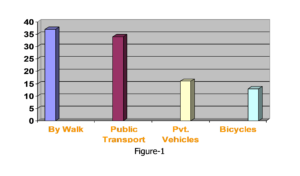
Children travel to school using different modes of transport depending on their social background. There are 3538 schools in Bangalore city with a student population of around 11 lakhs. A preliminary survey conducted by traffic police indicate that 37% of school children walk to their respective schools, 34% use public transport 16% use private vehicles and 13% travel by bicycles.
The following graph illustrates the mode of transport used by school children in Bangalore
 Majority of the school children who travel in private vehicles go to the central areas where prestigious schools are located. Usage of private vehicle for school children account for 20-25% of morning traffic as parents drive their children to school. As a result traffic congestion has increased around school the schools prompting more parents preferring to drive their children to school.
The use of unsafe private modes of transport along with auto rickshaws also contribute enormously to road accidents involving school children. The number of school children killed and injured for 3 years up to the year 2005 is given in the table below

The following pie chart provides vehicle wise fatal accidents involving school children
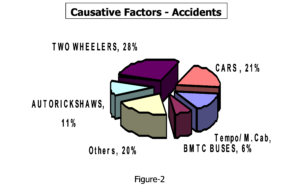
The above pie diagram shows that 49% of accidents involving school children are due to personalized vehicles such as two wheelers and cars.
THE INTERVENTION
Safe Routes to School is a local community based road safety programme for the schools managed by government as well as private schools. The Bangalore City Traffic Police in association with other agencies such as Bangalore Mahanagara Palike and Bangalore Metropolitan Transport Corporation decided to draw the plan using scientific methods. The main aim of this programme is to reduce the incidence and severity of the road crashes involving school children and reduce the traffic congestion around schools in the central area. The intervention has to be different for private and government schools owing to the difference in the availability of infrastructure, strength of school, mode of travel and socio economic condition.
THE OBJECTIVES
The objectives of the safe routes to schools programme are as follows:-
-
- To establish a partnership between local authorities and school communities including teachers and parents, in implementing a multi-action road safety intervention program for children.
- To identify the specific road safety problems for children along major routes in the local area used by children to travel to and from school.
- To develop, implement, maintain and evaluate appropriate education, engineering, encouragement and enforcement interventions that address the road safety problems for children.
- To raise awareness among people in the local community about road safety
- To encourage children to travel to schools using the safest routes.
- To consider change in timing of schools so as to stagger the morning and evening peak hours
THE APPROACH
The approach adopted for this programme:
-
- A partnership initiative bringing in the best practices from around the world. International agencies such as Global Road Safety Partnership (GRSP) were involved to share their experience of school traffic management in the West. Transport Training Institute and Consultancy (TTIC), a Bangalore based IT solution organization was involved in collection and interpretation of statistical data
- Multi agency involvement: – The Bangalore Mahanagara Palike, Bangalore Metropolitan Transport Corporation and department of Education, Government of Karnataka were involved in formulating and implementing key policies such as staggering of school timing and use of public modes of transport
- Public private partnership approach:- The school managements were involved in collection of data relating to different modes of transport used by school children and to bring desirable changes with the co-operation of parent –teacher associations.
- The scientific approach: – Such as
- Educational approach by teaching students the importance of safety skills and launching of drivers safety skills programmes
- The Engineering approach focusing on creating physical improvements in the infrastructure surrounding the schools, controlling the speed and establishing safer cross walks and path ways.
- The Enforcement approach to strictly enforce traffic laws and to ensure compliance by drivers.
THE SURVEY
In order to collect information about school traffic, two different questionnaires were prepared one for the government schools and another for the private schools. In the questionnaire sent to government schools, information sought was basically on the location of the school, the total number of students in each class, details of the school timing for primary, secondary and high school, pattern of travel, the number of students using various modes of transport and routes. This information was collected through respective Block Education Officers from 565 government schools.
Another questionnaire which was sent to private schools sought information regarding location of the school, strength of the school in each category such as primary, secondary and high school, details of school timings in each category the pattern of travel and number of students using various modes of transport and routes. Information was collected from 303 private schools directly from the school managements.
The major findings of the survey are
-
- Majority of the children in government schools are pedestrians as they walk from home to school
- Majority of the school children going to private schools in central areas use private mode of transport
- The traffic congestion is the worst around central area as parents bring their own vehicles to drop and pick-up their children
- Majority of the schools do not have space for parking inside the school
- The two wheelers and auto rickshaws are the most unsafe modes of transport. Auto rickshaws ply more children than the stipulated capacity.
- Only a few schools have their own transport fleet.
- Most schools favoured change in school timings.
- Many school authorities complained about lack of adequate safety environment around schools.
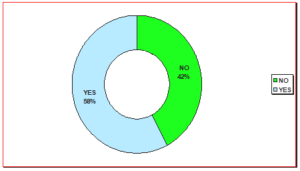
Survey on Change in School Timings
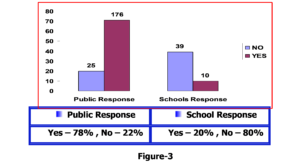
Cumulative Response by Public and Schools
After the preliminary survey in 565 government and 303 private management schools, a detailed survey was conducted in 16 schools which are located in the central area known for worst traffic congestion.
The schools are as follows;
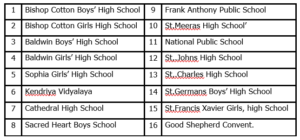
A joint team comprising 3 members was formed to visit all these schools and obtain first hand information about the problems prevailing around the schools.
Another questionnaire was used to capture a detailed information about travel pattern of the students and local observations for individual schools.
Travel Pattern of Bishop Cotton Girls High School
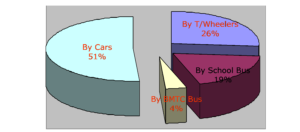
Travel Pattern of Baldwin Boys High School
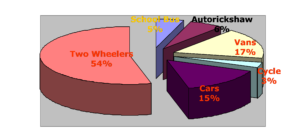
The problem identification process consisted of Travel Survey undertaken to identify the way the students travel to and from school, the major routes used to and from school, and road safety problems that exist along theses routes. A local observation survey is needed to study the vicinity of the school and identify the critical problems in engineering terms. Photographs were taken to study the problems existing in and around the school.
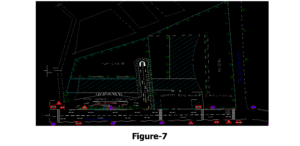
The topographic survey was undertaken to map all the existing features prevailing at any given school and to know the extent of space availability for planning of interventions.
After the Topographic survey had been completed existing site maps of each of the above-mentioned schools were developed.
Based on the availability of land within school, the schools were subdivided as
-
- Schools with Land
- Schools without Land
- Features of the Plan for School with Land are:
- Traffic Management
- Traffic Regulation
- Circulation of Traffic
- Off-Street Parking
- Medians
- Signage
- Regulatory Signs
- Informatory Signs
- Road Humps
- Road Crossings
- Barricading
- Footpath Upgradation
2. Features of the Plan for School without Land
-
- Traffic Management
- Traffic Regulation
- Circulation of Traffic
- On-Street Parking
- Raised Platform
- Signage
- Regulatory Signs
- Informatory Signs
- Road Crossings
- Barricading
- Footpath Upgradation
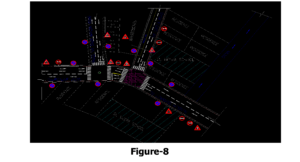
The recommended action plan was developed as a concerted effort and would address the four key components
Education:- a comprehensive road safety education program dealing with crossing the roads, walking on footpath walking along the roads and the issues that address the specific needs of the students.
Engineering-Improvements to the local traffic environment, which will improve the safety for students as pedestrians, bus commuters, two wheeler riders etc.
Encouragement-for parents to reinforce key safety messages to their children.
Enforcement-to address the illegal and unsafe behaviour. Individual plans are developed based on information obtained from these schools.
Basically the plans developed within school, must provide for the safe alighting and boarding of students into the vehicles and create separate entry points to streamline vehicular traffic and provide pedestrian facilities around the school campus. Allow the vehicles in to the school as per the plan Request letter to the parents. Raising awareness levels for the school children
Monitoring the plan and giving adequate feed back to the school authorities
THE ACTION PLAN
After a careful analysis of the survey findings the following Action Plan was developed.
-
- Staggering of school timings: It was decided to change the school timings so as to ensure that school timings should not clash with regular office hours. It was recommended to start all schools before 8:30am and to close before 3:30pm.
- Usage of public transport: Usage of public mode of transport was recommended as the ideal mode to ensure safety and also to achieve decongestion.
- Engineering: Overall improvements in the local traffic environment to improve safety for students as pedestrians and as bus commuters.
- Education: Comprehensive Road Safety Education Programme for school children under the umbrella of Student’s Association for Road Safety (SARS)
- Enforcement: This is basically to deal with illegal and unsafe behavior of drivers of school vehicles and others to ensure maximum compliance of traffic laws.
IMPLEMENTATION OF SAFE ROUTES TO SCHOOL (SRTS)
Safe Routes to School project was launched in the month of April 2005. The Bangalore city Traffic Task Force took keen interest in the project and a series of meetings were held, involving the main stake holders i.e., Bangalore Traffic Police, Education Department, Bangalore Mahanagara Palike and Bangalore Metropolitan Transport Corporation. Education Department after holding meetings with the school managements issued the following two notifications to stagger school timings and encourage public mode of transport:
-
- GO No. ED 52 PMA 2005 Dated 25/04/2005.
- GO No. ED 52 PMA 2005 Dated 27/05/2005.
In order to implement the Education Department circular for usage of public mode of transport, the Bangalore Traffic Police through a notification imposed ban on parking of all the private vehicles around the 16 identified schools in the central area.
Apart from mandatory notifications, meetings of parent-teacher associations were also held in each school of central area wherein senior police officers Bangalore Metropolitan Transport Corporation officials and Bangalore Mahanagara Palike Engineers participated. In these meeting efforts were made to convince parents regarding traffic de-congestion and usage of public transport.
Bangalore Metropolitan Transport Corporation introduced schools specific buses at a concessional rate and even deployed lady conductors for these buses.
EVALUATION OF SAFE ROUTES TO SCHOOL
After initial protests and resentment the Safe Routes to School was finally implemented in the month of July 2005. It was ensured that all schools other than government schools start before 8:30am and close before 3:30pm. Bangalore Metropolitan Transport Corporation introduced 207 school specific buses for central area schools where police banned parking of private vehicles during school opening and closing hours. Many schools purchased new buses and started their own transport fleet. In some schools where the space was available vehicles were allowed inside and parking facility was provided for car pool vehicles.
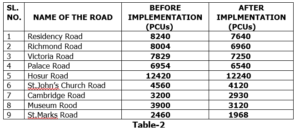
Traffic congestion was reduced by 20% – 25% in the central area in the morning and evening peak hours. The density of the traffic on the following roads before and after the implementation is as follows.
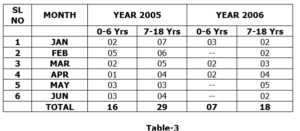
The implementation of this programme also resulted in greater safety for School Children. The following table illustrates number of school children killed in the first 6 months of the year 2006 when compared with the figures of 2005.
CONCLUSION
The success of Safe Routes to Schools Programme lies in the team work. Nothing can be achieved in isolation. This type of programmes will give an opportunity for law enforcing authorities to work closely in association with community and other governmental and non-governmental organizations and also involving the active participation of parents, students and school managements. This has set an example as to how traffic decongestion can be achieved by integrating Education, Engineering and Enforcement activities. Further there is a need to study and plan for implementation of similar type of programmes in the areas which are prone to traffic congestion in the ensuing years.
“Let us join hands and lead the way for better, safer roads for the children of today and leaders of tomorrow”